

- Keywords:
- UVSSsupplier Since2000 SEENBOOM
A checkpoint can buy the most advanced anomaly-detection model on the market and still drown in false alarms. When the chassis image feeding that model is stretched, warped or badly stitched, the algorithm is being asked to compare geometry that no longer matches the vehicle. Across the under vehicle surveillance market, most complaints about AI accuracy trace back to this one unglamorous cause: the image itself. This article explains what distortion actually costs a checkpoint, what distortion-free scanning means in engineering terms, and why imaging quality has to come before AI.
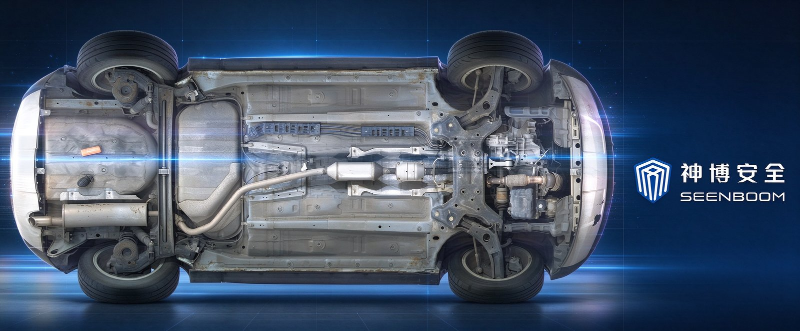
A true-to-scale full-width chassis scan - every component keeps its real proportion, the starting point for reliable AI comparison.
01 What Distorted Images Cost a Checkpoint
Distortion is not a cosmetic defect. A wide-angle lens, an uncalibrated multi-camera rig or a stitching engine that rescales strips differently will compress the edges of the chassis and stretch the centre. A bracket that is 30 centimetres long can appear 25 centimetres in one zone and 36 in another - and small attached objects sit in exactly the compressed zones where an operator would least expect them.
AI baseline comparison then fails in the most expensive way. The system archives a clean reference scan of each registered vehicle and highlights what changed on the next pass. If the second scan is warped differently - the vehicle sat a few centimetres off centre, crossed at a slightly different speed, or the optics were recalibrated - every bolt appears to have moved. The model reports dozens of changes that are pure geometry. Operators learn to ignore the alarm panel within a week, and the checkpoint is quietly back to manual visual review.
The workload lands on people. Every false positive needs an operator to open the image, zoom, compare and clear it. At a busy gate that means dozens of interventions per hour; at a border lane or a summit entrance it becomes a queue. Manual review also reintroduces the human variability the UVSS was bought to remove. Ask a site manager why AI underperformed and the honest answer is usually 'we stopped trusting the alerts' - not 'the model was too small'.
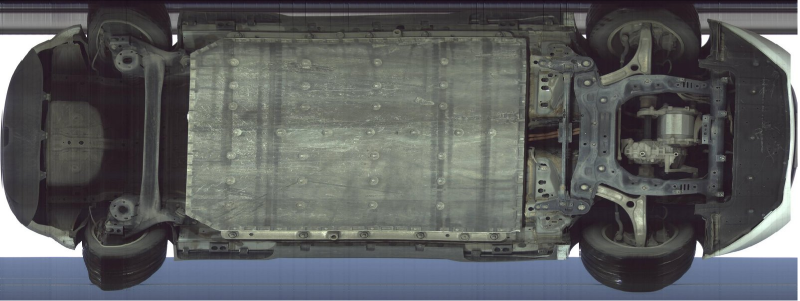
An illustrative poor-quality capture - dropped strips, banding and stretched geometry. This is what an AI baseline comparison is left to work with.
02 What Distortion-Free Scanning Actually Means
Distortion-free does not simply mean high resolution. In an under vehicle scanning system it means the image preserves true geometric proportion from bumper to bumper: a 30 cm component occupies the same number of pixels whether it sits at the centre of the chassis or at the outer edge, and the stitched panorama does not stretch, bow or taper as the vehicle crosses the deck. That requires calibrated line-scan optics, a known and constant capture geometry, and a stitching pipeline that maps sensor lines to physical distance rather than simply gluing frames together.
The distinction shows up most clearly on low-clearance vehicles. A sealed flat floor - the kind of profile people search for as a Tesla Roadster undercarriage - leaves very little visual texture for an algorithm to lock onto. When the panorama is true to scale, the floor pan, suspension arms, battery enclosure and wheel wells keep their real spacing, so a small added object is still a measurable difference from the baseline. Warp the same image and that object becomes just another smudge inside a stretched panel.
In specification terms, the test is simple. Ask to see a full-width sample scan of one real vehicle at the lane's stated pass-through speed, then measure a known component at the centre and at both edges. If the proportions disagree, no amount of AI tuning downstream will recover them. The distortion-free under-vehicle scanning system overview documents the reference geometry Seenboom designs to.
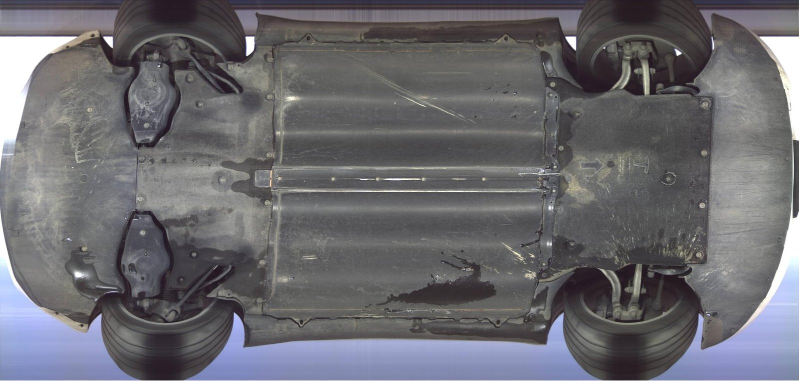
A Tesla Roadster undercarriage captured as a clean, true-to-scale scan - flat floor pan, suspension and wheels in real proportion. Low-clearance EVs are the hardest geometry test for AI comparison.
03 Why AI Anomaly Detection Depends on Clean Geometry
A model can only be as stable as the pixels it receives. When geometry is consistent, baseline comparison becomes a genuine change-detection task: the same vehicle, the same scale, a difference confined to one bounded region. False negatives fall because small attachments remain visible at the chassis edges. False positives fall because mud, factory brackets and heat shields sit exactly where the reference scan says they should. Operator review turns into exception handling instead of a full-time filtering job.
That stability is what high-security projects are actually buying. Prisons, government compounds, border crossings and critical-infrastructure gates do not need an impressive demo - they need an audit trail that still holds up months later, across rain, dirt, firmware updates and a mixed fleet. Clean geometry is also what makes an under vehicle scanning system usable with third-party platforms: a true-to-scale panorama, a plate, a timestamp and an alarm region export cleanly through an open API, while warped images quietly break that evidence chain.
Buyers comparing under vehicle surveillance system price sheets should therefore weight imaging geometry above camera count. It is also where the under vehicle surveillance market is heading: procurement teams no longer ask how many lenses a deck carries, they ask for a measured false-alarm rate on real traffic and sample scans from a site that has been running for six months.
04 How Seenboom Builds Distortion-Free Imaging
Seenboom develops its own line-scan optical path instead of assembling generic area cameras. Sensor geometry, LED illumination and encoder-triggered capture are designed together, so each sensor line maps to a fixed physical strip of the lane. Stitching is a calibrated mapping, not a photo merge - the panorama keeps true scale at every pass-through speed within specification, with no edge stretching and no tapered joints. This is the engineering core of Seenboom's under vehicle scanning system range.
The same principle runs across the fixed and portable ranges. Fixed decks are engineered for permanent lanes - buried or surface-mounted, IP68-sealed, rated for heavy vehicles, integrated with ANPR, barriers and the site VMS. Portable kits carry the same imaging chain in flight cases for temporary checkpoints that appear for a summit or a major event. Both feed one AI comparison engine, and both support fully offline, air-gapped deployment on Linux or Kylin editions where the site requires it. Seenboom has worked on under-vehicle imaging since 2000, contributed to the 2014 industry standard and delivered more than 2,000 lanes - these optics are the product of that production history, not a lab prototype.
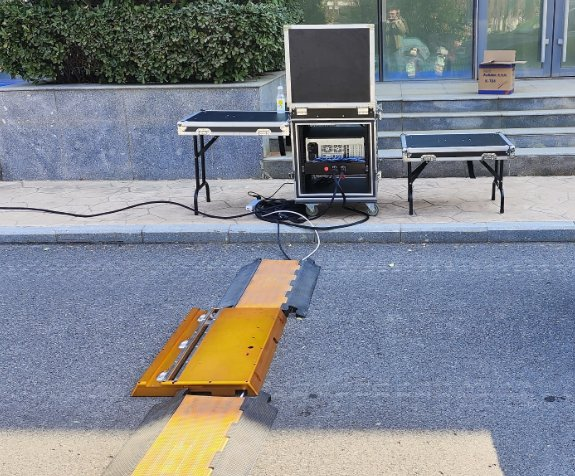
A portable scanning deck and control unit set up on a live road surface - distortion-free capture without any civil works.
05 Frequently Asked Questions
Q: Can better AI fix a distorted image?
A: No. A model can learn to tolerate some warping, but it cannot recover geometry that was never captured consistently. Fix the optics and the stitching first, then tune the model on real checkpoint traffic.
Q: Is this the same product as a 'uv resistant vehicle price display'?
A: No. A uv resistant vehicle price display is an outdoor, weatherproof sign at a car park, toll lane or dealership showing tariffs. A UVSS is a security scanning device. The two search terms sound similar because both contain 'UV', but a checkpoint project only needs that signage if the site also displays parking or toll prices.
Q: What does the under vehicle surveillance system price actually depend on?
A: Mainly the imaging class (fixed or portable, distortion-free optics), lane width and load rating, the AI baseline and offline software edition, ANPR and VMS integration, and local service response. Ask for a quotation that itemises these separately - the Under Vehicle Scanner Price Guide 2026 breaks the cost structure down. A cheap deck that produces warped images costs more in operator hours than it saves.
06 Bottom Line: Imaging Quality Is the Foundation of AI
AI anomaly detection is only as trustworthy as the chassis image underneath it. Distorted geometry breaks baseline comparison, floods operators with false alarms and quietly returns the checkpoint to manual inspection. True-to-scale, stitch-clean imaging is not a premium feature - it is the precondition for everything the model is asked to do.
If you are evaluating an under vehicle scanning system, start with one request: a full-width sample scan of a real vehicle, at your lane speed, with a known component measured at the centre and at both edges. Seenboom can provide sample scans, a live online demonstration of baseline comparison and alarm review, and a proposal built around your lane drawings and vehicle mix. Contact zhangxiaohui@seenboom.com or WhatsApp +86 183 6310 1063.

Visitors review live UVSS imaging with the Seenboom team at a security exhibition - sample scans and integration questions answered face to face.