

- Keywords:
- UVSSsupplier Since2000 SEENBOOM
Under Vehicle Surveillance System (UVSS): The Complete Buyer & Deployment Guide for Security Checkpoints | SEENBOOM
Manual under-vehicle checks are slow, easy to miss things, and leave no record. A mirror on a stick depends on one inspector's attention, produces no evidence, and stops the queue at exactly the wrong moment. An under vehicle surveillance system replaces that guesswork with a scanned, archived image of every chassis that crosses the lane. This guide explains how UVSS works, which specifications actually matter, where the technology fits, how to avoid low-cost traps, and how to deploy it without surprises. A downloadable UVSS selection checklist and specification sheet are linked at the end.

AI-assisted UVSS screening at a major-event vehicle checkpoint - automated undercarriage inspection without stopping the queue.
01 What a UVSS Is and How It Works
An under vehicle surveillance system is a complete checkpoint imaging chain: a scanning deck, sensors, cameras, an operator workstation and the software that ties them together. The term UVIS, or under vehicle inspection system, is often used for the imaging and inspection module alone, and the two names are used interchangeably across the industry. What matters to a buyer is not the acronym but the scope of delivery - imaging hardware alone is not a screening system.
The hardware is straightforward. Sealed line-scan camera modules and LED lighting sit inside a deck mounted in or on the lane. A loop or radar sensor detects the approaching vehicle and triggers capture; an ANPR camera reads the plate; the workstation stitches the camera frames into one continuous image and shows it alongside the plate, time and lane ID. Barriers, road blockers and a VMS connection complete the lane where the site requires them.
The scanning flow takes seconds and does not require the vehicle to stop. As it crosses the deck at controlled low speed, the cameras capture the underside strip by strip, the software assembles a full-width panorama, and the result is archived automatically. That combination - a repeatable image, a permanent record, and continuous traffic flow - is the core value of any under vehicle inspection system, and the standard every cheaper alternative should be measured against.
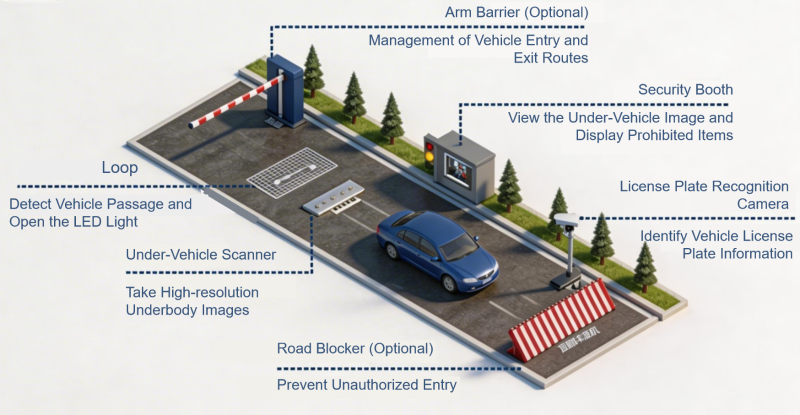
Typical fixed UVSS lane layout - loop sensor, scanning deck, ANPR camera, control room and optional barrier, shown in one system diagram.
02 Where Low-Cost UVSS Offers Go Wrong
The most common trap is image distortion. Stretched edges, uneven stitching and motion artefacts hide small attachments exactly where a concealed object would be placed, and they make baseline comparison meaningless. Seenboom documents this in its distortion-free under-vehicle scanning system overview, which is worth reading before comparing quotations - if a vendor cannot show a clean full-width sample scan of a real vehicle, the specification sheet is fiction.
The second trap is AI that has never seen a working checkpoint. Models trained on a handful of tidy sample images flag loose heat shields, mud and factory brackets all day long, and operators stop trusting the alarms within a week. The remaining traps are equally predictable: housings that are not IP68-rated and fail after one wet season, software that insists on a cloud connection when the site demands an air-gapped network, closed protocols that cannot talk to an existing VMS, and decks whose load rating quietly excludes the trucks the lane actually serves.
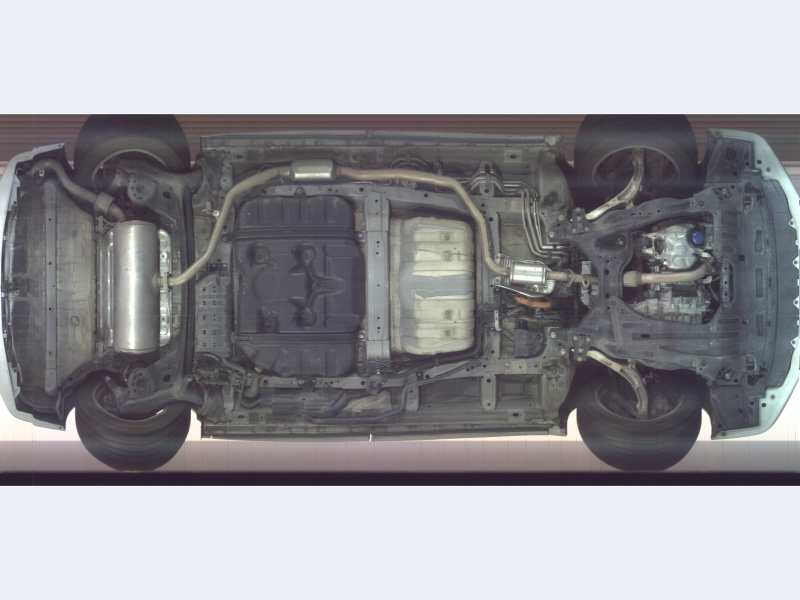
A clean, distortion-free full-frame undercarriage scan - the reference image quality every buyer should demand before purchase.
03 The Core Specification Checklist
Six items decide whether a UVSS works for five years or for one pilot. Imaging comes first: distortion-free stitched panoramas, stable line-scan capture at the specified pass-through speed, and enough resolution to resolve a fist-sized object at the edge of the chassis. Protection comes second: IP68-sealed housings, wide-temperature operation and a deck rated for the heaviest vehicle on site, not the average one.
Third, confirm the operating system. Government, defence and critical-infrastructure sites routinely require Linux or Kylin-based offline, isolated deployment with local storage - a system that needs a cloud account is disqualified before the demo. Fourth, ask for AI baseline comparison: the system should archive a clean scan per registered vehicle and highlight what changed on the next visit, with a false-alarm rate measured on real traffic. Fifth, insist on RTSP and ONVIF video output plus an open API, so the UVSS joins the existing command platform instead of creating a silo. Sixth, verify load rating, pass-through speed and local retention in writing, with the test conditions attached.
These six points also make a fair RFQ. Ask every supplier the same questions, in the same order, and compare the answers - not the marketing adjectives. Our UVSS supplier checklist breaks the same evaluation into twelve checkable points.
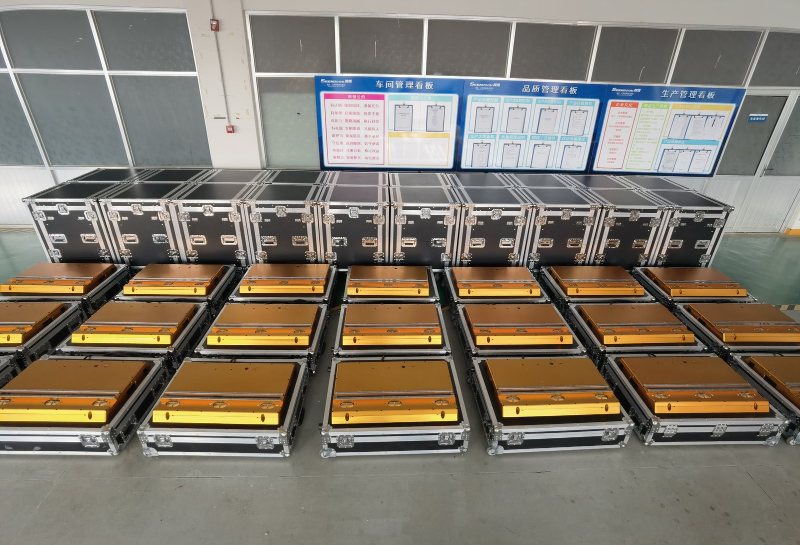
IP68-sealed scanning decks staged in flight cases - industrial hardware built for outdoor lanes and repeated deployment.
04 Fixed vs Portable UVSS: A One-Line Selection Rule
Fixed UVSS is the right answer for a permanent lane with high, predictable traffic - border crossings, ports, prison gates, airport service roads and industrial park entrances. The deck is buried or surface-mounted, cabling and drainage are engineered once, and the lane runs for years with minimal attention. Portable UVSS exists for the opposite case: a temporary perimeter that appears for a summit, an exhibition, a sporting event or a VIP motorcade route. The kit travels in flight cases, sits on the road surface and needs no civil works at all.
The one-line rule is simple: if the checkpoint will exist for years, buy fixed; if the security perimeter will exist for days, buy portable. Many operators eventually own both, because a fixed lane protects the daily perimeter while a mobile fleet covers the event calendar. For a full side-by-side comparison of imaging, deployment time and total cost, see the fixed vs portable under-vehicle scanners guide.
05 Where UVSS Is Actually Deployed
Borders and customs remain the largest application, where an under vehicle surveillance system screens freight and passenger vehicles without dismantling the traffic flow; the border UVSS project overview shows the permanent-lane pattern. Embassies, government compounds, courts and prisons use the same chain for credentialed entries. Airports, power plants, data centres and substations add vehicle screening to an existing access-control stack. Industrial parks and logistics hubs care as much about theft and cargo tampering as about threats. Major events and competitions rely on portable units, because their perimeter disappears the day the closing ceremony ends.
One newer use case deserves an honest note: electric vehicles. A UVSS captures the battery pack enclosure visually, so dents, added objects, displaced covers, leaks and unauthorised attachments are visible in the scan and in the baseline comparison. It does not measure cell health or state of charge - that belongs to the vehicle's own diagnostics - but as a security record of what is physically attached under an EV, the image is hard to argue with.
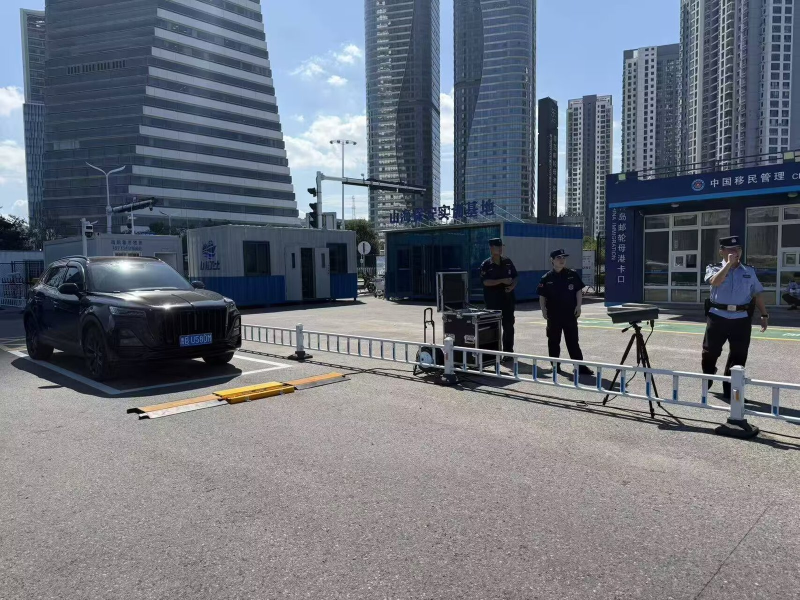
A permanent UVSS lane at an immigration and port checkpoint - scanning deck, ANPR camera and barrier in daily operation.
06 Integrator On-Site Deployment Checklist
A clean installation starts with a survey, not a purchase order. Record lane width and surface condition, the full vehicle mix including the heaviest truck, axle loads, peak hourly volume, available setback for the operator workstation, local climate extremes, and whether the lane is covered or open to rain. Then confirm the security requirement in writing: many government and defence projects demand fully offline, air-gapped operation with no external network path, which changes the software edition and the storage plan.
Next, map the interfaces. Which barrier or road blocker is already installed, which ANPR system owns the plate data, and which VMS or command platform will receive the video and alarm events? RTSP, ONVIF and an open API keep this integration simple. Finally, settle power supply, drainage and cable routing, and define acceptance criteria before delivery - sample scans of the same test vehicle at the agreed speed, a false-alarm test on real traffic, an IP68 ingress check and a documented handover. The custom UVSS projects guide walks through this path from survey to commissioning.
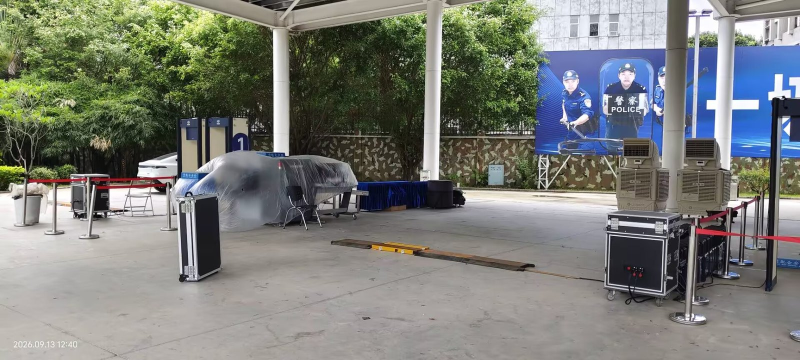
A temporary UVSS lane deployed inside a checkpoint tent - the portable pattern used for event and summit security.
07 How to Compare Quotations Without Getting Burned
Do not buy on paper parameters. Resolution, scan speed and AI accuracy are all measured under conditions the vendor chooses, so ask for a factory acceptance test on the actual vehicle types your lane will see, plus sample images from a site that has been running for at least six months. A scanner that looks impressive in a showroom and drifts after a firmware update is more expensive than a properly supported industrial unit at twice the price.
Weight three long-term factors above the sticker price: AI stability over seasons of dirt, weather and vehicle mix changes; the availability of spare parts, sealed modules and a service response in your region; and a clear firmware roadmap with offline update capability. Industrial-grade equipment and a low-cost entry kit may share a similar-looking deck, but they do not share a lifecycle cost - downtime at a border lane is measured in queues, not in invoices.
08 Why Choose Seenboom
Seenboom has focused on under-vehicle scanning since 2000: the 2003 area-array imaging work, vehicle security support for the 2008 Beijing Olympics and 2010 Shanghai Expo, participation in the 2014 industry standard, and more than 2,000 delivered lanes backed by 40-plus patents and 30 software copyrights. That concentration shows up in the details buyers care about - self-developed distortion-free imaging, AI trained on production checkpoint traffic, IP68 heavy-duty housings, Linux and Kylin offline editions, and open protocols that integrate with third-party platforms.
The same systems are delivered across multiple overseas regions through OEM and ODM cooperation, with CE conformity and documentation in English. From a single portable kit for a summit to a permanent border lane, the proposal is built around the site survey, not around a fixed product list. Contact the team at zhangxiaohui@seenboom.com to discuss your lane drawings and vehicle mix.
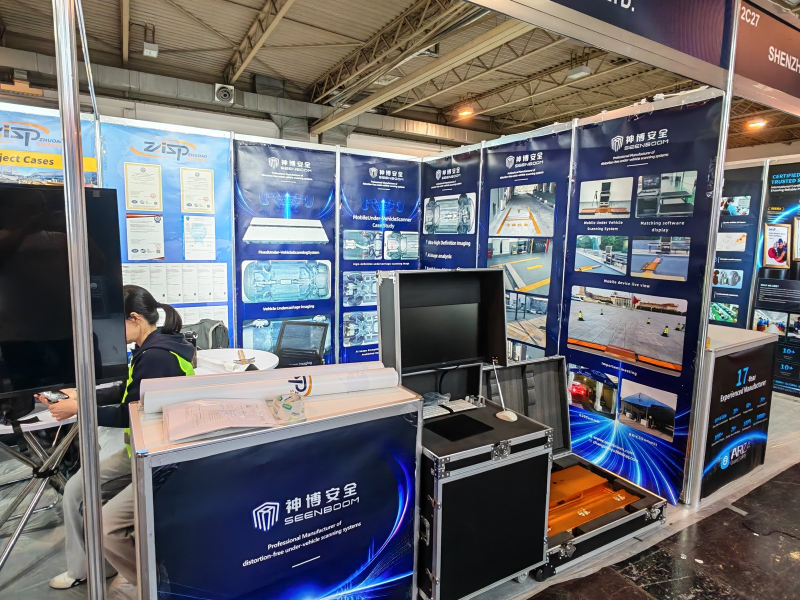
Seenboom's full UVSS product line presented at Security Essen 2026 - fixed, portable and AI scanning systems on one stand.
09 Frequently Asked Questions
Q: Does the vehicle need to stop for scanning? A: No. A UVSS captures the chassis while the vehicle crosses the deck at a controlled low speed, typically a few kilometres per hour. The driver keeps moving, and the image is ready before the vehicle reaches the gate.
Q: What is the difference between UVSS and UVIS? A: Both refer to under-vehicle screening. UVSS usually describes the complete checkpoint system with imaging, ANPR, software and records, while UVIS is often used for the imaging and inspection module. Buyers should confirm the exact scope of supply instead of relying on the acronym.
Q: Is distortion-free imaging really important? A: Yes. Stretched or poorly stitched edges hide small attached objects and break AI baseline comparison. Ask for a full-width sample scan of a real vehicle at the specified speed before accepting any quotation.
Q: Can the system run fully offline with no cloud connection? A: Yes. Linux and Kylin editions support air-gapped deployment with local storage, local AI processing and offline updates - a standard requirement for government, defence and critical-infrastructure sites.
Q: Can it detect EV battery abnormalities? A: It can show physical anomalies on the battery pack enclosure - dents, added objects, displaced covers, leaks - and flag them against the baseline image. It does not diagnose internal cell health; that remains a vehicle-diagnostics function.
10 Next Steps: Checklist, Demo, Cases and a Custom Proposal
Four things are ready for your project team. Download the UVSS selection checklist and specification sheet to run a like-for-like RFQ. Book an online technical demonstration to see a live scan, a baseline comparison and an alarm review. Ask for project cases from your own region to check references and deployment conditions. And send your lane drawings, vehicle mix and offline-security requirements to receive a tailored proposal with layout, equipment list and commissioning plan.