

- Keywords:
- UVSSsupplier Since2000 SEENBOOM
On cost, insist on a line-by-line quotation rather than a headline figure: hardware priced by configuration tier with the UV-resistant enclosure grade on its own row, then civil works, commissioning, maintenance and software licences listed separately. Buyers hunting for a 'UV resistant vehicle price display' are in practice asking for exactly that - a quotation where weatherproofing and configuration sit next to the money instead of buried in an annex. Two offers written that way can be compared honestly; two single-number quotes cannot. The full cost arithmetic for fixed and mobile lanes is set out in the UVSS price guide.
03 Which One Fits Your Project
Once the site is described honestly, the answer usually announces itself. Work down these lists and stop where you recognise yourself.
Choose a fixed scanner if the checkpoint will be staffed at the same location for years, if it regularly clears several hundred vehicles a day, if the lane has to keep the pace it already runs at, and if the project includes integration with ANPR, barrier control and the site security platform as part of scope rather than as an option.
Choose a mobile scanner if the operation runs for weeks or only at peaks, if several locations need screening in rotation, if the road cannot be cut because the site is leased or the surface is new, if capital works cannot be approved yet but the concept needs proving on site, or if the checkpoint moves by design - a seasonal crossing, a cordon, an incident response. In every one of those cases a buried pit is the wrong instrument: it arrives too late, or it cannot be justified.
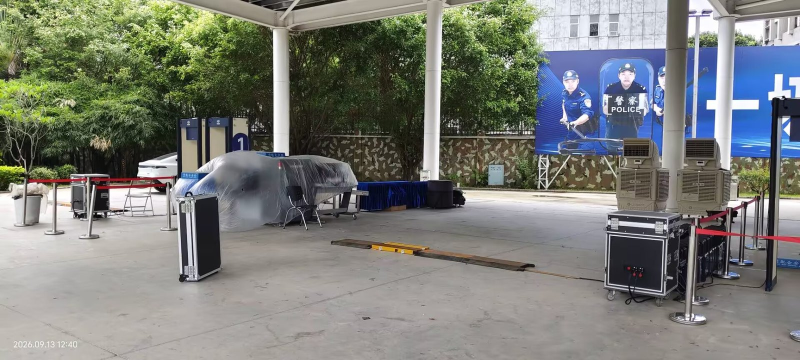
Temporary venue screening: a mobile deck in service for the duration of the event, struck when it closes.
Established checkpoints frequently end up with both, and it is worth planning that rather than arriving at it. Fixed lanes carry the daily load at full speed. A mobile unit covers the surge, the secondary entrance staffed only at weekends, and the fortnight when one buried deck is out of service. One operator reviews all of it from one queue because the software is identical. Deciding which lane receives the mobile unit before you buy changes the cabling, the traffic plan and where the secondary inspection bay goes - all cheaper on paper than on site, and set out step by step in how to design a vehicle inspection checkpoint.
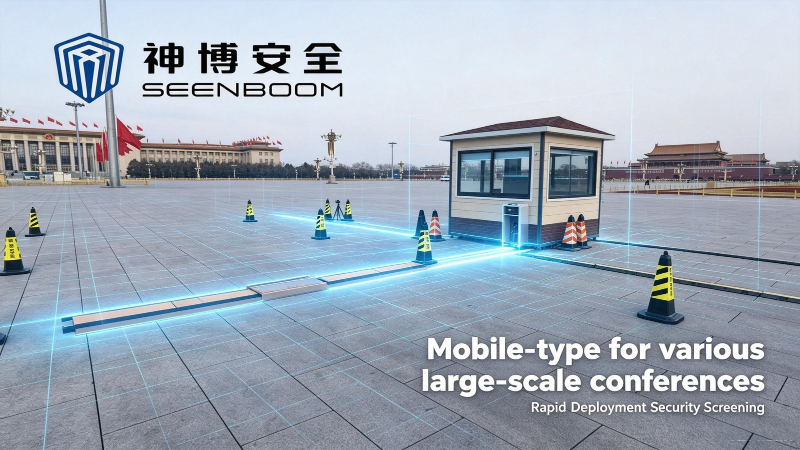
Mobile UVSS equipment ready for redeployment: one unit can cover several sites in rotation.
Permanent-looking sites are not always permanent either. A campus entrance or a hotel and commercial vehicle gate often looks like a fixed installation on a drawing, but the tenant may leave in three years, or the surface may be under warranty. A surface-mounted deck handles that middle case well: screening every day like a fixed lane, yet removable when the lease ends.
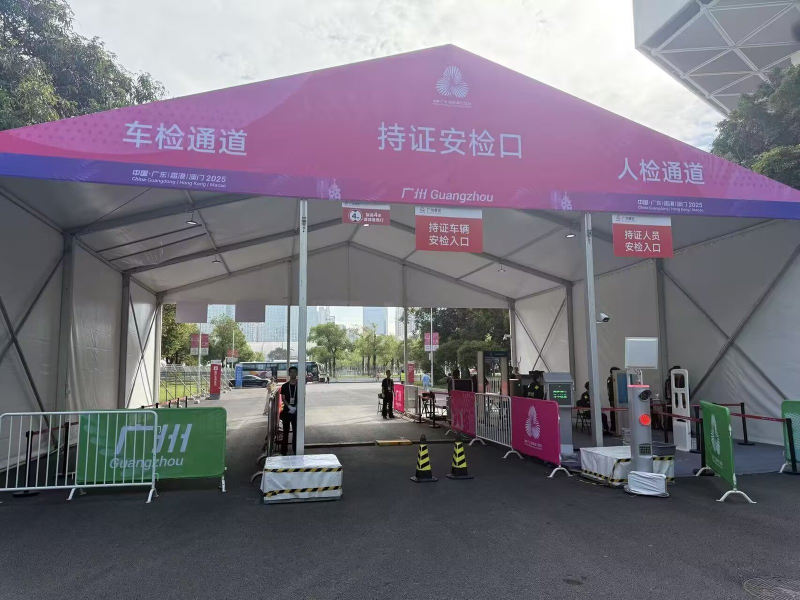
Under-vehicle scanning at a commercial entrance lane: permanent daily service without a deep pit.
04 Four Mistakes That Cost Money
Choosing mobile to avoid civil works, then hitting its throughput ceiling. A portable lane asks every driver to slow down, which caps vehicles per hour, and a deck engineered to be moved wears faster under continuous duty. Count vehicles at the peak hour, not the daily average, and count the hours the lane is staffed before you decide.
Under-scoping the fixed site. Pit depth, drainage, conduit runs, load rating for the heaviest axle and reinstatement of the surrounding surface are all cheaper to design in than to add later. A pit that floods every time it rains, or a deck rated below the tankers that use the lane every Thursday, turns into a costly retrofit and a lane closure nobody budgeted for. Where axle loads are uncertain, Seenboom's heavy-duty platforms are tested above 70 tonnes, and the supplier checklist covers the rest of the pre-purchase questions.
Assuming every mobile unit carries every integration. Compact models sometimes restrict simultaneous links or ship without a documented event API, so a unit that works standalone can arrive unable to push a scan record into the barrier controller or VMS. Ask for API documentation, sample event payloads and reference integrations before the purchase order, not after delivery.
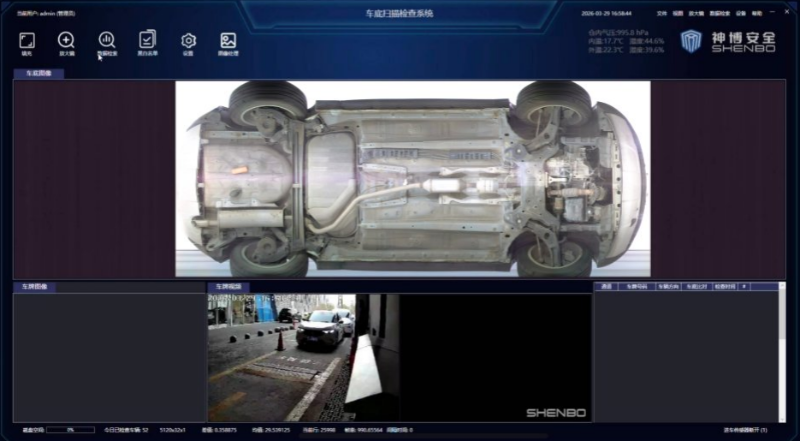
The review workstation is common to both platforms: the marked scan, the vehicle record and the decision in one place.
Comparing unit prices instead of total cost. A fixed line carries civil works and lead time but almost no running cost. A mobile unit starts cheaper and then carries setup labour, transport and earlier replacement - and it also earns money back by moving between projects, which is the single largest saving most fleets overlook. Compare three-year cost per site, not the invoice total, and note that the two lines cross somewhere between eighteen months and three years of continuous operation.
05 Five-Question Self-Check Before You Enquire
Answer these five questions in writing and you will get a firm configuration instead of a brochure - from Seenboom or from any serious supplier:
- What does the lane look like: width, gradient, surface condition, available power and network at the lane?
- How long does the requirement last: permanent, seasonal, or a fixed number of weeks?
- What is the traffic: vehicles per day, peak-hour count, and the heaviest axle expected?
- What must it connect to: ANPR, barrier control, VMS, existing visitor or credentials system?
- Can the road be opened, or does leasing, warranty or heritage rule it out?
The answers narrow the field to one platform about nine times out of ten. Send them with a site drawing - even a marked-up photograph is a start - and the response comes back as a configuration, an itemised quotation, and the civil works scope if the answer involves digging.
06 FAQ
Is a portable system as accurate as a fixed one?
For the image itself, yes: the same scanning modules and the same review software produce a comparable corrected scan of the chassis. The difference is not accuracy but duty cycle. A buried deck handles continuous traffic without asking anything of the driver, while a mobile deck trades a little throughput and more wear for its portability. Accuracy suffers in practice only when a mobile unit is set up on poor ground or heavy camber, or when its window is left dirty - both of which a cleaning routine fixes.
How much civil work does a fixed installation really need?
An excavation to suit the deck, a drainage sump and conduit run to the control cabinet, concrete, and time to cure - several weeks in total, with the lane closed for part of it. The hardware lead time runs in parallel, not after it, so plan both at once. If that scope cannot be approved, a surface-mounted fixed deck keeps the same platform and almost the same traffic behaviour with days of work instead of weeks, and it stays removable.
Can a project start mobile and move to fixed later?
Often it should. A mobile unit screens vehicles while the capital approval for a lane is still moving, which gives the authority evidence that screening works and a defensible specification afterwards. Because both platforms run the same software, the operator training and the integration into ANPR, barrier and VMS carry over. Plan the conduit and power positions during the mobile phase and the later installation is far less disruptive.
07 Conclusion
There is no better platform, only a better match, and the match is decided by three things: how long the requirement lasts, what the lane will physically allow, and how integrated the screening has to be with the rest of the checkpoint. Fixed wins on throughput, duty cycle and permanence, and it costs civil works and lead time to get there. Mobile wins on deployment speed and reuse across sites, and it costs throughput and a shorter service life if you run it every day. Most mature projects hold both, using fixed lanes for the daily load and one mobile unit for everything else. Either way, the scanner is one component of wider security checkpoint solutions, and it is the layer that sees the part of the vehicle no gate camera reaches - which is why it pays to specify it alongside the barrier, the cameras and the record-keeping rather than after them.
Seenboom builds both configurations and will quote either one - or tell you that the sensible answer is two fixed lanes plus one mobile unit held for the surge. Send the five answers above with a site drawing to zhangxiaohui@seenboom.com, or message WhatsApp +86 183 6310 1063, and you will receive a configuration, an itemised quotation and the civil works scope if there is one.