

- Keywords:
- UVSSsupplier Since2000 SEENBOOM
Seenboom will exhibit at Security China 2026 in Beijing from 3 to 6 November, and the stand will be running hardware, not slideware. Visitors can put a vehicle over the scanner, watch the undercarriage image build in real time, and take the resulting file away with them on a USB stick.
The unit on show is our current production system: area wide scanning with no stitching seam, AI detection of foreign objects and vehicle modification, IP67 and IP68 sealing, number plate and driver capture in the same lane, and an open web API. Fixed and portable variants will both be on the floor.
We are there to meet system integrators, government project contractors and regional distributors, with particular interest in the Middle East, Africa, Europe, Latin America and Central Asia. If you have a live tender, bring the drawings. If you are still scoping a site, bring the photographs. Either way, book a slot before you travel.
The booth number isBooth E2K11, China International Exhibition Center (Shunyi Hall), Beijing, China. Meetings booked in advance get a fixed time, a named engineer, and the documents you need sent ahead of the show.
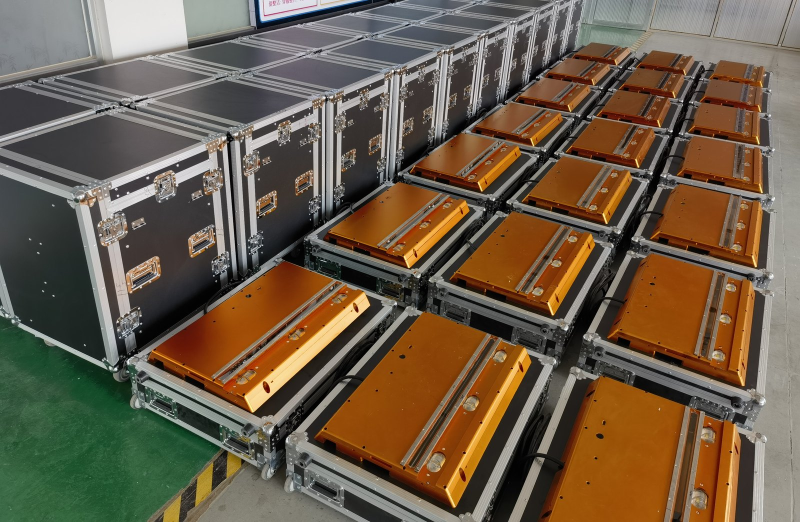
UVSS scanning modules on the production floor in Jinan, packed in flight cases for export.
01 What Security China Is, and Why It Is on Our Calendar
Security China is one of Asia's largest public security exhibitions. It has run since 1994 under the China Security and Protection Industry Association, with approval from the Ministry of Commerce, and it is the week when Chinese integrators, access control distributors and project contractors do their annual sourcing. For anyone buying checkpoint equipment, it is also the shortest route to the people who actually specify what goes into a lane.
The 2026 edition runs alongside the third Intelligent and Safety Industry Development Conference. The halls cover physical security, perimeter and access control, checkpoint screening and AI-assisted security, which puts under vehicle screening in the same building as the access control and video platforms it has to talk to.
There is a specific reason this matters to a buyer flying in. The organisers are running a Global Sourcing Lounge for invited purchasers from South America, Africa, the Middle East, Southeast Asia and Central Asia, with one-to-one meetings between exhibitors and buyers, as the October show announcement set out. A week in Beijing can therefore cover both the equipment and the channel. Dates, venue and access
The show runs 3 to 6 November 2026. Halls are open 09:00 to 17:00 on the first three days and close at 13:30 on the final day, according to the organiser's visitor guidance.
The venue is the China International Exhibition Center, Shunyi Venue, at No. 88 Yuxiang Road, Tianzhu, Shunyi District, Beijing. It sits next to Beijing Capital International Airport, which makes an arrival-and-walk-in the same morning realistic for most international flights.
Registration is free for pre-registered visitors and is done online through the official visitor portal. You will need the QR code that the system issues, plus your passport at the door. Allow twenty minutes for the badge print and the security check.
Our booth number isBooth E2K11, China International Exhibition Center (Shunyi Hall), Beijing, China.It will be added to this page, and every confirmed meeting will receive it by email before departure.
02 What We Are Bringing to the Stand
Six capabilities will be running on the stand, and all of them can be operated by the visitor rather than demonstrated at them. The hardware is shipping product, not a prototype.
Distortion-free imaging across the full width of the vehicle
Area wide scanning captures the whole undercarriage in a single exposure instead of assembling it strip by strip. There is no seam down the middle of the image and no stretch that grows with vehicle speed, so a bolt at the front axle and a bolt at the rear axle are drawn at the same scale. That is what distortion-free means in practice, and it matters the moment an operator has to measure something rather than simply look at it, which is the difference between a picture and evidence. The principle is set out in our area wide scanning explainer.
Wide coverage also changes the camera count. One sensor covers a lane that would otherwise need several narrow units and a good deal of alignment work, which reduces both the installation cost and the number of things that can drift out of calibration after a season of weather. On a long wheelbase van the same distortion-free frame still reaches both axles without a second pass.
AI that flags objects and modifications, not just shadows
The detection layer compares each vehicle against a clean reference rather than against a fixed brightness threshold. It marks added containers, welded repairs, non-standard panels, fresh impact damage and objects that do not belong on a road car, and it logs the class and the position alongside the image. A copper pipe and a bundle of cable no longer look the same to the software. Our notes on AI undercarriage detection cover what the model can and cannot be trusted to catch.
This is the part operators ask about most, because it addresses the real failure mode of manual screening. A guard watching a monitor for six hours does not miss things because the image is poor. He misses them because attention is finite. Flagging a handful of candidates per hundred vehicles is a workload he can actually sustain.
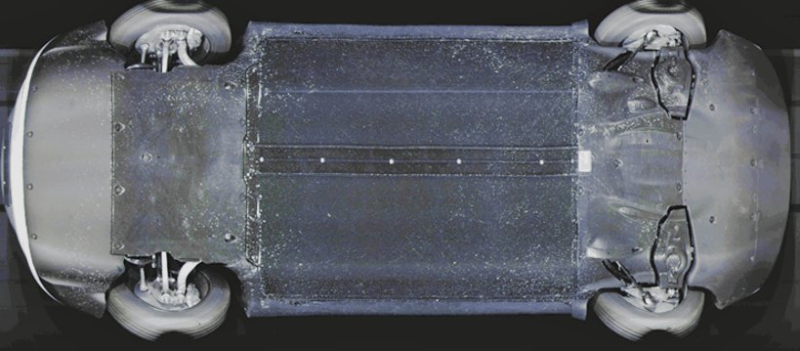
A battery-electric undercarriage captured as one undistorted frame
Sealed to IP67 and IP68 for sites that are never dry
The scanning modules are built to IP67 and IP68, which is the specification that matters when the lane is a port apron, a mine gate or a road that floods in monsoon season. Standing water, jet washing and a decade of grit are normal operating conditions rather than warranty arguments. Load ratings are quoted per model: the gdscds fixed unit is rated for vehicles above 70 tonnes, and the distor6308 carries 50 tonnes with a 5K imaging chain.
For a project engineer the useful part is that the sealing does not depend on a raised deck or a drainage pit. The unit sits flush with the road surface, so there is nothing to dam water and nothing to catch a low splitter. Sites that cannot excavate can still install a permanent lane, which is not true of every system on the market.
Number plate, driver face and undercarriage in one pass
The ANPR camera, the driver-facing camera and the undercarriage scan are triggered by the same vehicle event, so the three records are bound to one timestamp and one track. An operator pulls a single entry, not three files from three systems. The multi-camera configuration handles this on a single lane without a separate controller per device.
It is a small detail until a vehicle is stopped and somebody has to justify why. At that point, having the licence plate recognition result, the driver image and the floor of the car in one retrievable record is the difference between a two-minute conversation and a twenty-minute search through a folder tree.
An open web API instead of a locked console
Results are pushed into the site's existing security platform over an open web API, so the checkpoint appears in the same interface as access control and video rather than in a separate window somebody has to remember to open. The pattern is already standard across our fixed installations and our airport deployments.
Bring your platform's API documentation to the meeting and we will go through the field mapping on the stand. Integrators tend to have one awkward requirement that decides the whole integration, and it is much faster to find it in person than over a chain of emails.
Fixed, portable, and built to your badge
Both product families travel to Beijing. The fixed series is for permanent lanes where the unit is buried and forgotten about, and the portable series covers temporary checkpoints, event sites and locations where civil works are not an option. The control cabinet and temporary-site configuration will be shown alongside them.
For distributors and integrators who want to sell under their own name, we build OEM and ODM units with your badge, your colour and your documentation set. Terms are discussed case by case, and the conversation is better had in person than in a specification sheet. Our partnership page sets out the shape of those arrangements.
Where these systems are already running
The same hardware works at border crossings, diplomatic premises, prisons, energy sites, high-end corporate campuses and large event venues, and each one imposes a different constraint. A border lane has to absorb freight height and volume. A diplomatic gate has to protect the vehicle as carefully as it screens it. A prison has to log every movement on and off site. An energy site usually has no budget for civil works and no space for a pit. Under-vehicle inspection is not one product in six markets; it is six different lane layouts built around one imaging core.
Representative projects are written up on our prison, border and large event pages, and the airport guide covers lane geometry and throughput in more detail. If your site is closer to one of those than to the others, say so when you book and we will bring the matching drawings.
What actually happens at the stand
A pre-booked session runs about forty minutes. A vehicle crosses the unit, the image builds live on screen, and then the engineer pulls it apart: where the resolution is, what the AI flagged, what it deliberately ignored, and what the same vehicle would look like under a weaker camera chain.
Bring site drawings, vehicle dimensions and a photograph of the lane if you have them. A layout that takes three weeks to settle over email usually takes twenty minutes on a table with a drawing on it, and you leave with a mounting arrangement rather than a promise.
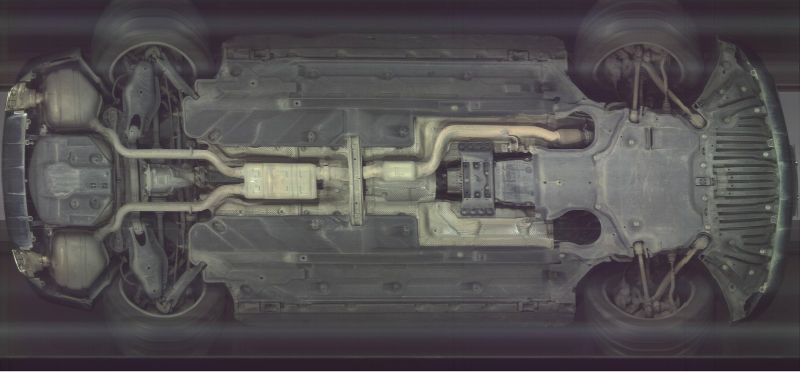
High-resolution undercarriage image used as the reference frame for AI comparison.
03 Why a Meeting in Beijing Is Worth the Trip
A specification argument takes ten minutes face to face
Most of the questions that stall a project are not commercial. They are technical: what happens to image quality at 40 km/h, how the unit behaves when a truck with a loaded trailer rolls over it, whether the sealing really survives a pressure washer, what the false alarm rate looks like across a thousand vehicles, and how ANPR copes with a plate caked in mud. Those answers are quicker to give with the hardware in front of you and a screen showing the output.
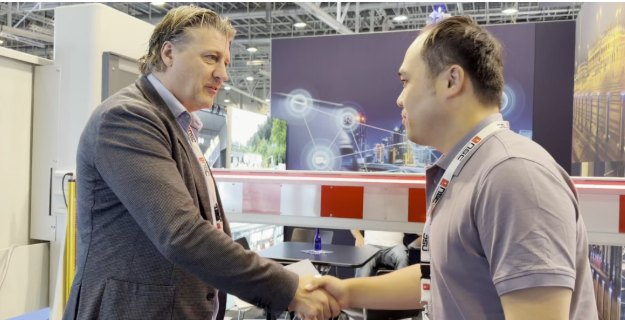
A technical review with an integrator at a previous exhibition.
Delivery terms are easier to settle in the room
We quote FOB, CIF and DAP depending on what the project actually needs, and the right choice usually depends on whether your side has a customs broker and how the site is reached. CE documentation and test reports are on hand. Discussing the Incoterm before the price is a much shorter conversation than negotiating a number and then discovering the delivery basis does not fit. Our price guide explains what moves the number.
The documentation usually matters more than the datasheet
Government and infrastructure projects ask for drawing packs, test records, CE certificates of conformity, material certificates and, on vehicle programmes, PPAP-style submission documentation. What we can provide depends on the programme, and it is worth checking against your own checklist before a tender closes rather than after. Bring the checklist.
The factory is under two hours from the show
Production sits in Jinan, which is a high-speed rail ride of under two hours from Beijing. Buyers who want to see the line, meet the engineering team and watch a unit being sealed and tested can add a day either side of the show. It is the difference between choosing a supplier from a catalogue and choosing one from a factory floor.
Regional exclusivity is a conversation, not an email
We are actively looking at distribution in the Middle East, Africa, Europe and Latin America, and the honest version of that discussion involves territory, volume, service capability and who carries the spare parts. None of it works well asynchronously. If you are already selling checkpoint or access control equipment into a region, come and make the case.
04 Book a Slot Before the Floor Opens
Send four things and we will confirm a time: your company and country, the site type, the vehicle mix you expect, and your project timeline. That is enough to put the right engineer in the room and to prepare the material you will actually use.
Email zhangxiaohui@seenboom.com with the show name in the subject line, message us on WhatsApp, or use the contact page. If you would rather not fix a time yet, send two or three windows that suit you and we will return a calendar invite. If you want to talk first, we can hold a short call before the show and keep the stand session for the technical part.
The booth numberisBooth E2K11, China International Exhibition Center (Shunyi Hall), Beijing, China. Everyone who books in advance gets it by email, along with a map of the hall and the name of the engineer they are meeting.
If you cannot travel this year, ask for a live walkthrough instead. We will run a video call from the stand during the show, point the camera at the screen and answer the same questions in the same order. It is not the same as being there, but it is considerably better than a PDF.
05 About Seenboom
Seenboom has worked on under vehicle surveillance since 2000 and began developing scanning systems built on area array sensors in 2003. The company supplied vehicle inspection equipment for the 2008 Beijing Olympic Games and the 2010 Shanghai World Expo, took part in drafting the national industry standard in 2014, and has supported Belt and Road transport security projects since 2017. More than 2,000 lanes are in service, backed by over 40 patents and 30 software copyrights.
The UVSS range covers fixed buried units, portable and trailer-mounted systems, AI detection software and lane controllers, sold to integrators, distributors and government programmes. Systems are running at ports, borders, airports, prisons, energy sites and event venues, including projects documented on our case pages. For the background to the technology, start with our guide to UVSS or the comparison of UVSS with mirror-based inspection.
06 Media and Business Contact
Sales and project enquiries: zhangxiaohui@seenboom.com. WhatsApp: +86 183 6310 1063. Media requests, including interviews with the engineering team during the show, should go to the same address with the word Media in the subject line and will be routed to the right person within one working day.
For company background and certification documents, see the company profile and our development history. Existing customers looking for support during the show week should use the normal service channel rather than the stand contact.