

- Keywords:
- UVSSsupplier Since2000 SEENBOOM
A border crossing does not get to choose its traffic. On an ordinary Tuesday a lane might clear four hundred vehicles. During a holiday movement, an evacuation, or the week when the neighbouring post closes for resurfacing, that number can double, and the extra vehicles arrive at the hours when the fewest staff are on shift. Most checkpoints absorb that swing the expensive way. They either build for the peak and carry the idle capacity all year, or they build for the average and fall behind on exactly the days that matter.
That tension is what the fixed-versus-portable decision is really about. One class of site is permanent: a gate that will screen vehicles, in the same place, for the same authority, for a decade or more. The other class shifts: a seasonal crossing, a cordon around a summit or a sporting event, a second entrance opened for three weeks while the primary lane is rebuilt. Both need the same picture of the underside. They need very different hardware wrapped around it.
For the second class, mobile UVSS for border checkpoint inspection has become the working default, and the reason has less to do with portability than with lead time. A mobile unit can be screening vehicles on the day it arrives. A buried deck needs excavation, concrete, drainage and a lane closure before it sees its first vehicle. Choosing wrong is not a small mistake either way: a fixed lane abandoned because the site moved is a capital write-off, and a portable deck left to carry a permanent lane will be worn out inside two years.
This guide is addressed to whoever specifies the equipment rather than whoever operates it — the integrator or procurement officer who has to defend the choice in writing. It covers what each platform is, what both platforms share regardless of price, a short checklist covering traffic, relocation, weather and budget, and the hybrid layout that most established checkpoints end up with. If you need the underlying technology first, start with how an under vehicle surveillance system builds a full-width image in a single pass.
01 What Is a Fixed Under Vehicle Scanning System?
A fixed under vehicle scanning system is built into the roadway. The scanner is a sealed steel deck holding the camera modules, the lighting and the glass, and it sits in a shallow concrete pit so that its top surface is flush with the lane. Vehicles drive over it at low speed, typically up to 30 km/h, and the scan completes without the driver stopping. There is no ramp to climb, no cable across the lane, nothing to aim at and nothing to avoid.
Flush mounting is the whole argument. Because nothing protrudes, a vehicle passes at whatever speed the gate already runs at, so the scanner never becomes the bottleneck it was installed to remove. That property is invisible in a specification sheet and obvious at 07:00 on a Monday, when the queue is the only thing anyone notices. It also removes the driver-error variable: a ramp asks every driver to do something slightly unusual, and a small percentage will do it wrong — too fast, at an angle, or straddling the edge.
What 5K pixel under vehicle scanning buys you
Resolution is the line most tenders argue about, so it is worth saying plainly what it changes. Across a full-width scan, 5K pixel under vehicle scanning puts roughly five thousand pixels over the width of the underside. At that density a reviewer can read a bolt head, follow a weld bead, and tell a factory bracket from one that was added last month. At half that density those details blend together, and the reviewer stops judging evidence and starts guessing.
Resolution sets the ceiling, not the outcome. Lighting, distortion correction and the angle of the modules decide whether those pixels are usable, which is why the number should always be quoted together with the claim of a distortion-free image. What 5K buys in practice is the ability to close a case on screen. Without it, a reviewer who sees something odd has to walk out to the vehicle with a mirror, and the lane stops while they do.
Load rating, sealing and drainage
Three further numbers decide whether a buried deck survives its site. The load rating: a lane used by fuel tankers, refuse trucks or armoured carriers needs a deck rated well above the heaviest axle it will ever meet. Seenboom's heavy-duty fixed platform is sealed to IP68 with a structure tested above 70 tonnes, and the general-purpose unit is rated at 50 tonnes. The ingress rating: IP68 is not an adjective, it is a test — dust-tight, and able to withstand continuous immersion under conditions the manufacturer states. And drainage: water will reach the pit, the only question is whether it leaves. A buried deck needs a sump and a conduit run designed in from the start, not added after the first flood.
The cost that is not in the unit price
A pit has to be excavated and poured, drainage and conduit have to reach the control cabinet, and the lane has to close while concrete cures. Depending on the site that is several weeks of lead time and a civil budget that can match or exceed the hardware. The lane is then fixed in place: if the gate moves, the deck stays where it is.
In exchange you get a platform designed to run every day for years with almost no attention, which is why permanent sites keep choosing it — airport perimeter and cargo gates, seaport and customs lanes, prison sally ports, utility and data-centre entrances, and the main carriageway of any border crossing that will be staffed indefinitely. Customs and border agencies treat the vehicle underside as a primary concealment route; the World Customs Organization's enforcement material is a useful reference when you write the threat case into a tender.
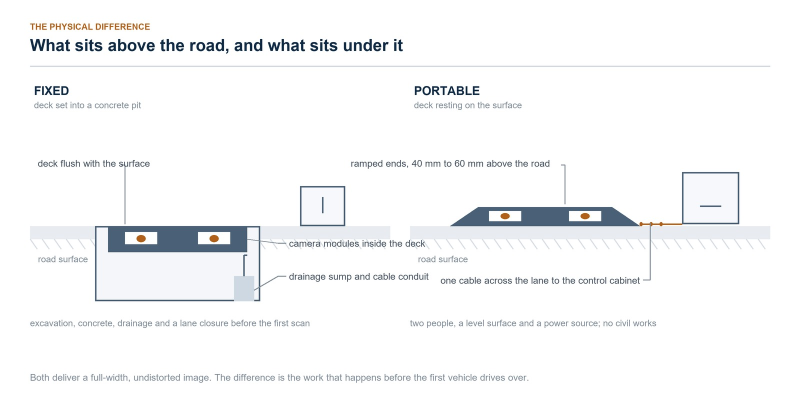
Cross-section of a fixed UVSS deck set flush in a concrete pit, and a portable UVSS deck resting on the road surface with one cable to the control cabinet.
02 IP68 Portable Mobile UVSS for Temporary Checkpoints
An IP68 portable under vehicle scanner is the same idea stood on its side. Instead of cutting the road to accept the scanner, the scanner rests on the road. It is a shallow deck with ramped ends, typically 40 to 60 mm above the surface at the highest point, with sealed camera modules and lighting inside and one cable running to a roadside control cabinet. Two people can carry the sections, lay them on a firm, reasonably level surface, and be screening vehicles in well under an hour.
That turns a checkpoint into something you deploy rather than something you build. There is no excavation, no lane closure for concrete, and no conversation with a highways department about reinstatement. When the operation finishes, the deck is struck, loaded and in use somewhere else the following week. For any authority that has to justify capital works, that difference is usually decisive.
Mobile UVSS for Border Checkpoint Inspection
Border work is where the portable case is strongest, and it is not only about posts that are temporary by design. Four situations come up repeatedly. A seasonal or secondary crossing that is staffed for part of the year. A surge lane opened beside a permanent crossing when queues build beyond what the fixed lanes can clear. A temporary cordon during an incident, when traffic is redirected through a point that has never been screened. And a site where the authority cannot yet commit to civil works and needs evidence that screening works before it funds a lane. In all four, a buried deck is the wrong instrument: it arrives too late, or it cannot be justified for a post that will close.
The trade-offs are honest ones and should be written into the specification rather than discovered on site. Ground clearance: a low coupé or a loaded saloon may scrape the ramp, so check the fleet before you buy. Throughput: drivers slow for the ramp, so a portable lane clears fewer vehicles per hour than a flush one. Surface: the deck wants firm, fairly level ground, and loose gravel or a cambered road will cost you image quality. Custody: a unit left overnight at an unstaffed post needs to be locked down or taken with the shift. Seenboom's border checkpoint case page covers one crossing where these constraints had to be settled together.
Anyone specifying a rugged UVSS for high-security sites should look past the ingress rating at the parts that fail first. The connectors and the cable entry are the usual starting points, followed by whether the deck can be driven over by a loaded truck without flexing, and whether the housing actually drains. Sand is harder on portable equipment than rain is: fine dust works into threads and mating faces on any unit that is set up and struck repeatedly, so specify the connector rating and a cleaning routine alongside the housing. National border agencies publish their own durability expectations for field equipment — Border Force in the United Kingdom is one publicly documented example worth quoting back at a supplier.
03 Core Shared Feature: Real-time Image Comparison
Buyers often assume the two platforms run different software. They do not, and this is the part of the decision that should be separated from the hardware entirely. A portable deck and a buried deck use the same area wide scanning modules and feed the same review workstation, and the most valuable function on that workstation is automatic comparison of each scan against a stored reference.
Real-time image comparison works against two references. The first is a baseline for the chassis type: the system aligns the incoming scan to a stored reference for that model and scores each region for deviation. The second is the vehicle's own history. Where a plate string is available, the scan is also compared with the same vehicle's earlier passes, and that second reference catches the slow changes — a compartment built up over three months looks unremarkable against a model baseline and obvious against the vehicle's own file from January.
What this removes is the part of the job that breaks people. An officer who has to hold a mental picture of every chassis type will do it well for two hours and badly for eight. A comparison engine does not tire, does not rotate onto a new shift, and does not need the site's vehicle mix committed to memory. The reviewer is handed a short list of marked regions and a decision, which stays doable at hour ten. The detection side of this is covered in more detail in AI anomaly detection for undercarriage screening.
Two conditions apply, and both belong in the specification. The baseline has to be built from your own vehicle mix rather than a generic library, because a crossing that sees mostly one or two local models will get a far tighter baseline than a general one, and asking for a generic baseline is how systems end up noisy. And the system must report low confidence when conditions are poor instead of returning a clean result — a muddy chassis in heavy rain is a reason to escalate to manual inspection, not a pass. Ask to see the behaviour with a deliberately dirty vehicle before you accept a demo.
04 Quick Selection Checklist for Security Integrators
Four questions decide most tenders. They are ordered by how quickly they eliminate an option, so work down the list rather than weighing all four at once. In practice the first two usually settle it.
Traffic volume and duty cycle
Count vehicles at the peak, not the average, and count the hours the lane is staffed. A flush fixed lane keeps vehicles moving at gate speed and is engineered for continuous duty; a portable lane asks every driver to slow for the ramp, which caps throughput and puts the wear on a deck designed to be moved. As a working line: if the lane will run every day for years and regularly clears several hundred vehicles, specify fixed. If it runs for weeks, or only at peaks, specify portable.
Will the site move?
Ask the question that never appears in the tender document: does anyone expect this checkpoint to be somewhere else within three years? Road realignments, lease expiries, a new terminal building, and changes to which authority controls the gate are all common, and all of them are invisible to a specification written around today's drawing. If the honest answer is maybe, portable wins regardless of what the traffic count says, because the cost of being wrong is the whole civil works budget.
Rain, dust and ground clearance
Both platforms are sealed to IP68, so rain alone is not the deciding factor. Standing water is: a buried deck has a sump and drainage designed into the pit, while a portable deck sitting in a puddle will produce a degraded image and should say so rather than returning a clean pass. Dust behaves differently again — fine sand at a desert crossing works into connectors and threads on equipment that is set up and struck repeatedly, so specify the connector rating and the cleaning routine, not just the housing. Then check ground clearance across the fleet you actually expect: low vehicles will scrape a portable ramp and will cross a flush deck without noticing.
Budget and the whole-life number
Compare three-year cost, not unit price. A fixed lane's capital cost carries civil works, a lane closure and several weeks of lead time; after commissioning its running cost is close to zero. A portable unit costs a fraction of that up front and carries setup labour, transport, and earlier replacement if it is run every day. The two lines cross somewhere between eighteen months and three years of continuous operation. Before that, portable is cheaper; after it, fixed is. The published cost drivers for UVSS break out which items move that crossover at a given site.
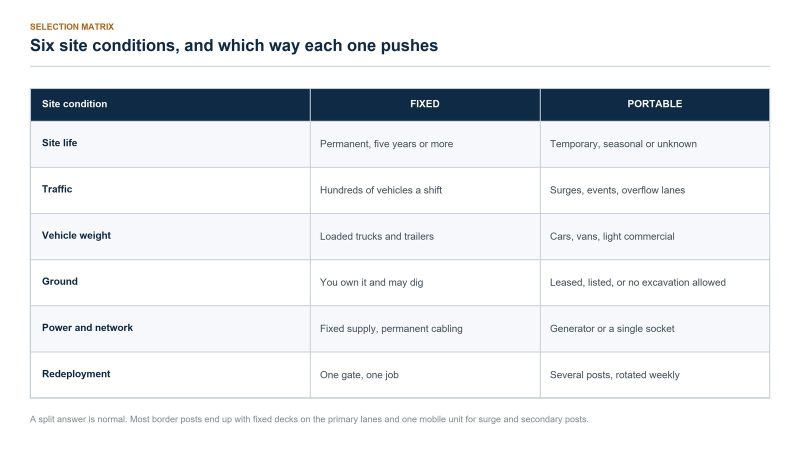
Selection matrix for fixed versus portable UVSS: traffic volume, site permanence, weather and ground clearance, and whole-life budget.
05 When the Answer Is Both: Hybrid Lanes
Most established checkpoints end up with both platforms, and it is rarely a decision anyone made in advance. A site opens with two fixed lanes sized for the normal load. Then a summit, a holiday movement or a resurfacing project arrives, capacity has to double for a fortnight, and somebody buys or hires a mobile unit for the overflow. Three years later the mobile unit is part of the site.
Done deliberately, that is the strongest configuration available. The fixed lanes carry the daily load at full speed with no ramp to negotiate. The mobile unit covers the surge, the secondary entrance that is staffed only at weekends, and the week when one deck is out of service. One operator reviews all of the lanes from a single queue, because the software is the same on both.
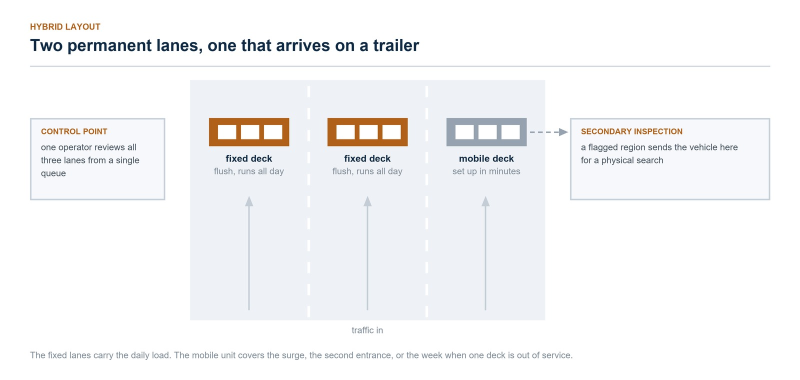
Hybrid checkpoint layout: two fixed lanes carrying daily traffic, one mobile deck covering the surge lane, both reporting to a single control point.
Two rules make it work, and both are easier to honour at design time than to retrofit. Standardise on the software first: if the mobile unit reports into a separate workstation, the operator ends up watching two screens and the advantage disappears. And decide in advance which lane receives the mobile unit when it deploys, because the answer changes the cabling, the traffic plan and where the secondary inspection bay sits. The wider layout question is covered in how to design a vehicle inspection checkpoint.
06 Conclusion
There is no better platform, only a better match. Fixed wins on throughput, duty cycle and permanence, and it costs civil works and lead time to get there. Portable wins on deployment speed and redeployment, and it costs throughput and a shorter service life under daily use. Both deliver the same corrected, full-width image of the underside, both run the same comparison against stored references, and both are routinely installed at the same checkpoint without anyone treating that as a compromise.
If your requirement reads like a border post that will be staffed for years at the same location, specify a fixed lane and budget the civil works honestly. If it reads like a crossing that opens seasonally, a lane that absorbs a surge, or a site that needs to prove the concept before it funds concrete, then mobile UVSS for border checkpoint inspection is the right instrument, and it can be screening vehicles the day it arrives.
Seenboom builds both and will quote either, depending on what the site plan says. Send us the site drawing and a week of traffic counts and we will tell you which one we would put in — or whether the sensible answer is two fixed lanes plus one mobile unit held for the surge. You get back a configuration, a bill of materials, and the civil works scope if the answer is fixed. Write to zhangxiaohui@seenboom.com or message WhatsApp +86 183 6310 1063; a turnkey proposal including installation, commissioning and operator training is available through the bidding and partnership page.
FAQ
What is the difference between portable and fixed UVSS?
Installation, and everything that follows from it. A fixed UVSS is set into a concrete pit so the deck sits flush with the lane. It needs civil works and a lane closure, it cannot be moved afterwards, and it will handle traffic at gate speed for years with almost no running cost. A portable UVSS rests on the surface as a low ramp. It needs no civil works, two people can set it up in under an hour, and it can be struck and redeployed to another site the same day. The scan itself is comparable: both produce a full-width, corrected image of the underside, and both run the same review software, including automatic comparison against a stored reference. The portable unit trades throughput for that flexibility, because drivers slow for the ramp and a deck engineered to be moved wears faster if it is run every day.
Does UVSS support automatic image comparison?
Yes, on both platforms. Each scan is aligned to a stored baseline for the chassis type and scored region by region for deviation; where a plate number is available, the scan is also compared against the same vehicle's earlier passes, which catches changes made gradually rather than all at once. The reviewer receives a short list of marked regions with confidence scores instead of a raw image to search by eye. Two conditions matter when you specify it. The baseline should be built from your own vehicle mix, because a crossing that sees mostly two or three local models will run a far tighter baseline than a general one. And the system should be configured to report low confidence when the chassis is wet, muddy or badly lit instead of returning a clean pass, so that a poor image escalates to manual inspection rather than closing the case.