

- Keywords:
- UVSSsupplier Since2000 SEENBOOM
AI Anomaly Detection for UVSS: Boost Undercarriage Inspection Efficiency
A border lane that clears six hundred vehicles in a shift gives each one roughly eight seconds of attention. In those eight seconds the officer at the screen has to answer a question that sounds simple and is not: is there anything under this car that should not be there?
The imaging half of that question was solved years ago. A modern under vehicle surveillance system produces a full-width, high-resolution picture of the underside in a single pass, sharp enough to read a bolt head. What hardware did not solve is the judgement. The picture still lands in front of a person who has to compare it, from memory, against every chassis they have seen before.
Human review fails in three predictable ways. It is slow, because reading an unfamiliar chassis takes time the queue does not have. It is inconsistent, because the same indentation looks like damage at the start of a shift and like a threat at hour eleven. And it depends on experience that cannot be copied to a new site: an officer who knows what a Hilux fuel tank looks like will spot a false floor in seconds, while a new recruit will not.
AI anomaly detection for UVSS attacks the judgement step rather than the imaging step. It does not search for a catalogue of known threats, because concealment is designed not to look like anything in a catalogue. It learns what a given chassis normally looks like, then flags the regions that do not match: a box behind a fuel tank where the floor pan should be flat, a weld that was not there last month, a mass that has no mechanical reason to exist.
Paired with no-distortion undercarriage imaging, that changes the officer's job from searching to confirming. The system proposes; the person decides. Everything else in this article follows from that division of labour: how the detection works, how it connects to ANPR and access control, where it earns its cost, and where it still needs a human eye.
01 How AI Anomaly Detection Works in Under Vehicle Scanning
Anomaly detection is often confused with object detection, and the difference decides whether a system is useful at a checkpoint. Object detection answers a closed question: is there a person, a weapon, a bag? It works when the target has a stable shape. Anomaly detection answers an open one: does this differ from what we expect? For undercarriage screening the second question is the only one that scales, because the thing you are looking for is whatever the last person decided to hide.
A photograph is not a decision
Plenty of systems marketed as AI-enabled produce a picture with a red box on it. That is an output, not a decision. An operator who cannot see why the box appeared will either ignore it after the third false alarm or stop the lane for everything, and both outcomes cost more than the software saved.
A usable result carries three things: the region, a confidence score, and the reference image the region was compared against. The third is the one buyers forget to ask for, and it is the one that makes a review take four seconds instead of forty. The officer is not being asked to trust a model. They are being shown a difference.
The baseline is built per chassis, not per fleet
Two vehicles of the same model, three years apart, do not share an underside. Exhaust routing changes, underbody cladding changes, a tow bar is added, a protective plate is fitted after a repair. A single average image of "a car" is therefore useless; the baseline has to be specific enough that a legitimate difference is not flagged and a concealed one is.
In practice this means the model is trained on the vehicles that actually use the lane, not on a generic street-scene dataset. A lane that sees mostly light commercial vans needs a very different baseline from an embassy gate that sees armoured sedans. Coverage of the local fleet matters more than the sophistication of the network architecture, and it is the first thing to interrogate when a vendor claims high accuracy. Seenboom has been collecting undercarriage images since 2000 and building area wide scanning systems since 2003, which is the least interesting fact about the company and the most relevant one here: baselines are made of years, not algorithms.
The comparison step, in plain terms
Four things happen between the scan and the alarm. The new image is registered against the reference, so that a vehicle stopping ten centimetres further forward does not shift every part on the screen. It is divided into regions that correspond to structure rather than to a fixed grid. Each region is scored for how far it departs from the baseline. And the scores are ranked against a threshold that the site can tune.
Straight pixel differencing does not survive contact with a real lane. Rain leaves a different pattern every pass, dust settles unevenly, headlights throw shadows, and a wet floor reflects the frame. A system that compares raw pixels will alarm on all of it. Working systems compare structural features and segmented parts, and they treat a change in brightness as noise rather than evidence.
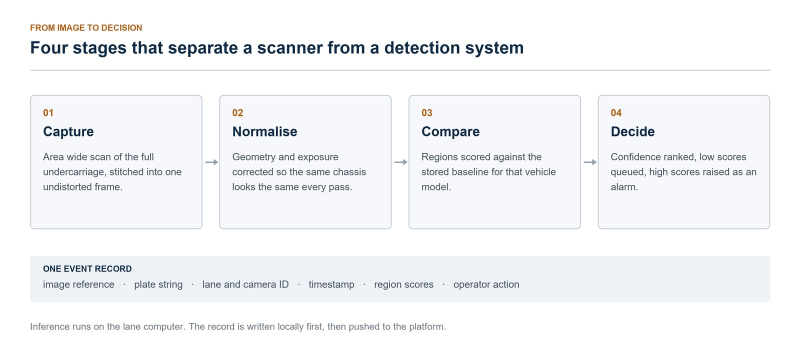
Four stages of AI anomaly detection for UVSS: capture, normalise, compare and decide.
The same vehicle, six months apart
Most anomaly detection compares a vehicle against its model baseline. Fewer systems compare a vehicle against itself. The second comparison is the one that catches patient concealment: a false panel welded in gradually, a compartment that grows by a few centimetres each month, a spare wheel that is swapped for something heavier.
Making that work requires a plate string to use as a key, a retention policy long enough to be useful, and a privacy position that the site can defend. It also requires the imaging to be repeatable: if the geometry of the scan changes between passes, the comparison degrades into noise. Where those conditions hold, longitudinal review is the most valuable thing an AI undercarriage system can do, and almost nobody asks for it at the tender stage.
Why no-distortion imaging sets the ceiling
An algorithm cannot recover geometry that the lens destroyed. If the centre of the undercarriage is stretched and the edges are compressed, the same bracket has a different shape depending on where the vehicle stopped, and every comparison downstream inherits that error. No-distortion undercarriage imaging is therefore not an adjective in a brochure. It is the precondition for comparing one pass with another.
Getting there is an optical problem before it is a software one. Multiple sensors have to be stitched without visible seams, at a consistent scale, under a deck that survives being driven over. Seenboom's fixed systems use multi-lens stitching to output a distortion-free panoramic image in the 5K class, sealed to IP68 and rated for vehicles up to 50 tonnes. Those numbers matter less as specifications than as conditions: a deck that floods, flexes or fogs will produce images that no model can compare reliably.
02 Key Integration: UVSS + ANPR and Access Control Systems
A detection that stays on its own monitor changes nothing. The value appears when the result enters the workflow the site already runs: the barrier opens or does not, the record lands in the case file, the shift supervisor sees the same event the lane officer saw. That is an integration problem, and it is where most projects lose time.
One event, many systems
The unit of exchange is an event, not a video stream. A complete event carries the image reference, the plate string, the lane and camera identifiers, a timestamp from a synchronised clock, the region scores, and the operator's disposition. Without the last field you have an alarm log; with it you have an audit trail that can answer a complaint six weeks later.
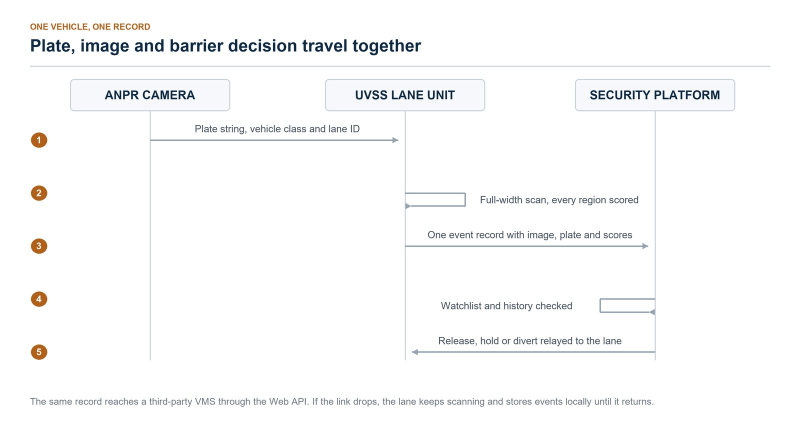
How one vehicle event passes between ANPR, the UVSS lane unit and the security platform: five handovers, one record.
ANPR integration: the plate is the key
Number plate recognition turns an image into a record that can be found again. With ANPR integration in place, a scan is no longer attached to a moment; it is attached to a vehicle. That single change enables the longitudinal comparison described above, lets a supervisor pull every pass by a van that visited three times last week, and allows a whitelist of scheduled vehicles to be reviewed at a lower level of scrutiny without being skipped entirely.
The practical detail that decides whether this works is timing. The plate read and the scan have to refer to the same pass, which means a shared trigger, a synchronised clock and a defined tolerance. Systems that grab the plate from a separate camera on a separate clock drift by a few hundred milliseconds and start attaching plates to the wrong vehicle, usually in exactly the congested conditions where the lane matters most.
Web API integration: what an integrator should ask for
"Do you have an API?" is the wrong question, because the answer is always yes. The useful questions are narrower. Is the event pushed or polled? Which authentication method is supported, and can it run over mutual TLS? How is the image retrieved, and is there a thumbnail small enough for a mobile client? What happens to events during a network outage? Which time zone and format does the timestamp use? How long are records retained, and can retention be set per site?
A Web API integration that answers those six questions can be joined to a video management platform, a physical security information system or a gate controller without a custom project for every site. One clarification saves a month: ONVIF covers video streaming and device discovery. It does not describe a business event such as "undercarriage anomaly, confidence 0.87, lane 3, plate unknown". You need a real API for that, and a vendor who cannot show one has not integrated with anything.
When the link goes down
Checkpoint networks fail more often than vendors admit, and a lane that stops screening because a switch rebooted is a security incident in its own right. Inference therefore has to run on the lane computer, results have to be written locally first, and the queue has to drain when the link returns. The same edge box should be hardened like any other network device: no default credentials, a segmented network, and logs that someone actually reads.
03 Where This Smart Under Vehicle System Is Deployed
Five types of site buy an under vehicle surveillance system for five different reasons, and the configuration follows the reason rather than the catalogue. The common thread is that the cost of a miss is high enough to justify a second pair of eyes that never blinks.
Border crossings and customs posts
A border lane has to do two contradictory things: move freight quickly and inspect it properly. Concealment methods vary with the traffic, from false bulkheads in cargo vans to objects strapped above a fuel tank, and the WCO's enforcement work keeps documenting how quickly those methods change. Fixed decks handle the primary lanes; mobile units cover secondary areas, inspection bays and overflow. Where throughput is the binding constraint, real-time undercarriage threat detection matters less for its speed than for its consistency at hour ten of a night shift.
Airports
Airport screening is not only about passengers. Staff vehicles, catering trucks, fuel bowsers and construction traffic cross into airside areas every day, and those are insider routes rather than stranger routes. A vehicle that passes the same gate twice a day is exactly the case where a per-vehicle baseline outperforms a generic one. The airport UVSS guide covers the lane geometry and the access-control handshake in more detail.
Embassies and government compounds
Diplomatic sites usually have one narrow entrance, a hard stop, and a requirement that screening not look like a military checkpoint. A flush-mounted deck suits that brief: no ramp, no visible machinery, nothing for a photograph to linger on. Speeds are low, which helps image quality, and the threat model is dominated by vehicle-borne explosives rather than contraband, so the baseline has to include official and armoured vehicles that never appear in a commercial dataset.
Prisons and correctional facilities
In a prison the undercarriage is a delivery route for phones, drugs, tools and SIM cards, often in small packages wedged above a shield or taped inside a bumper. The volume is lower than at a border and the vehicles repeat, which makes longitudinal review unusually effective. Seenboom has supplied screening equipment to correctional facilities in China, and the prison case reference describes a typical layout. Comparable deployments cover border checkpoints and airport access roads.
Ports, utilities and data centres
Critical infrastructure adds a quieter use case: not finding contraband, but proving that no unauthorised vehicle reached a transformer yard, a fuel farm or a loading dock. Here the record matters as much as the alarm, because the question after an incident is usually "what passed this point, and when" rather than "why did nobody stop it".
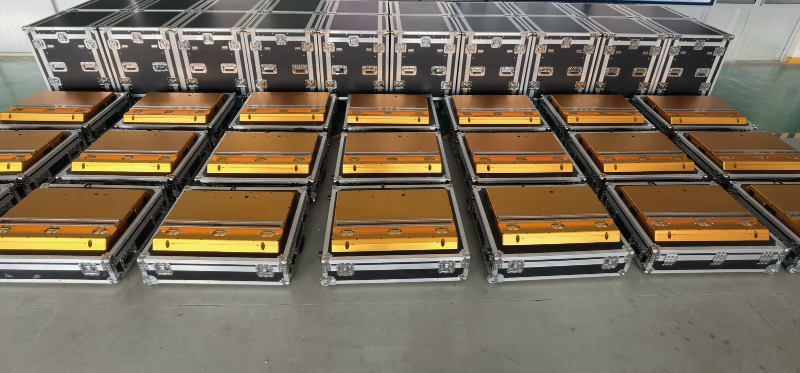
Mobile scanning decks on the production floor, built for temporary checkpoints and event security.
04 Advantages Over Conventional UVSS
The honest comparison is not AI against a human being. It is assisted review against unaided review, with the same person, the same lane and the same camera. Framed that way, the gains are easier to justify and harder to overstate.
Throughput and staffing
A careful manual review of an unfamiliar chassis takes between forty-five and ninety seconds, and most of that time is spent deciding where to look. When suspect regions are already ranked, the same officer typically clears a clean vehicle in fifteen to twenty-five seconds and spends the saved time on the vehicles that were flagged. On a lane handling two hundred vehicles an hour at peak, that difference decides whether a second inspector is needed on the night shift.
The staffing argument is therefore not redundancy. It is redeployment: fewer people staring at clean images, more people available for physical searches, dog sweeps and the second-line checks that software cannot perform.
Consistency across shifts and sites
A tuned threshold behaves the same way at 06:00 and at 23:00, on a Monday and on a public holiday. That sounds like a small thing until an operator runs several gates and has to explain why one of them stops four times as many vehicles. Comparable data across sites is also what turns a security budget conversation from anecdote into evidence.
Evidence that survives a challenge
Every alarm stores the image, the region, the score, the plate and the disposition. If a carrier disputes a delay, or an investigation asks whether a particular van was screened on a particular date, the answer is a query rather than a search through recorded video. Retention rules should be written before the system is switched on, not after the first request arrives.
Where AI still needs a person
Mud, snow, standing water and recent underbody repairs all degrade detection, and they do it on the same days when traffic is worst. Trailers, low-loaders and modified off-road vehicles fall outside the baseline entirely. A system that reports high confidence in those conditions is lying to you; a system that reports low confidence and asks for a human is working as designed.
This is why the review interface matters as much as the model. If the officer cannot compare the flagged region with the reference in one screen, the detection only moves the work rather than reducing it. Buyers evaluating UVSS manufacturers should ask for a live demonstration on their own vehicle mix, not a curated video, and should insist on seeing what happens with a dirty chassis. Budget for the system through the published cost drivers rather than a single per-lane figure, because integration and civil works usually decide the total.
05 Conclusion
Return to the lane at two in the morning. The queue has not slowed, the officer has been watching a screen for six hours, and the next vehicle is a van the lane has never seen. The difference between a good outcome and a bad one is not whether the camera is sharp. It is whether the officer is looking at a picture or at a ranked list of differences with the evidence attached.
That is what AI anomaly detection for UVSS is worth buying: not autonomy, but a shorter path from image to decision, the same standard applied on every shift, and a record that still makes sense a month later. It works on fixed decks and on temporary sites, with the same event model feeding access control, ANPR and the audit store.
If you are specifying a system, send us a sample of your own lane footage and vehicle mix. We will tell you what the baseline would need to cover, which parts of the underside will remain difficult, and whether the case for detection holds at your volume. That conversation is more useful than a specification sheet, and it usually takes twenty minutes.
FAQ
How does UVSS detect hidden vehicle modifications?
It compares what it sees with what it expects. The system holds a baseline for each chassis type that uses the lane, aligns the new scan to that baseline, and scores every region for deviation. A modification shows up as structure without a mechanical reason: a compartment where the floor pan should be flat, a bracket that does not match the model, a weld line that is not part of the original body. Where a plate string is available, the scan is also compared with earlier passes of the same vehicle, which catches changes that were made gradually and would look normal against a model baseline. The output is a ranked region with a confidence score, not a verdict; a person confirms it.
Can mobile UVSS work in rainy outdoor conditions?
Yes, within limits. Mobile decks are built to the same sealing standard as fixed units, typically IP68, with sealed housings, drainage and connectors rated for temporary immersion. Rain on its own is not the problem; standing water deep enough to cover the deck, heavy spray from a truck tyre, and mud carried onto the surface are. Image quality drops in those conditions and the system should report lower confidence rather than a clean result. Practical measures help: a raised or drained approach, a quick wipe between vehicles, and a rule that severe weather reverts to manual review. The mobile UVSS guide covers siting and power for temporary checkpoints.