

- Keywords:
- UVSSsupplier Since2000 SEENBOOM
On 15 October 2026, Tesla drove a Roadster up a curved ramp outside Waco, Texas, held it upside down against the ramp, and let it launch off the top. The car rotated in the air and landed back on its wheels. Elon Musk's summary afterwards was that it worked, and that flying cars are real.
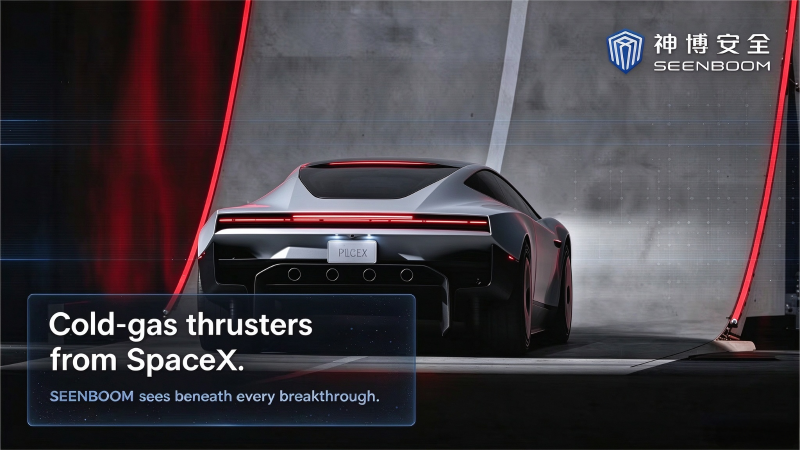
No wings were involved. The car pins itself to the road with a fan system that pulls air out from underneath the body, and it moves through the air on about ten cold-gas thrusters, the same principle SpaceX uses for attitude control on a booster. Tesla claims the suction system produces enough downforce for 2g cornering, and that the thrusters deliver several times the force the tyres can put down. The detail is reported in full by Electrek, along with the part most headlines skipped.
It is worth stating how large the leap is. For the whole history of the car, grip has come from two things: the rubber touching the road and the weight pressing down on it. The Roadster adds a third. It evacuates the air beneath its own floor to pin itself down, then pushes itself through a corner on gas it carries for itself. Sustained cornering at 2g used to be a number you read off a Formula One telemetry trace, on a car built for one circuit and one driver. Delivering it in something with a windscreen, a boot and a registration plate is not an incremental gain. It is a different set of rules.
The numbers hold up under scrutiny. Road specification reaches sixty miles an hour in under 1.6 seconds. The circuit version is quoted below 0.9. The single-seat version gets under 0.59, which puts a road-registered shape ahead of a Grand Prix car off the line. Tesla also found space for a 260 kilogram compressed air supply, around ten thrusters and a suction plenum in a body that still carries occupants and luggage. That is packaging work of the kind that only happens when a single company controls the chassis, the battery, the software and the aerodynamics at the same time. Whether or not the car ever reaches a customer, the demonstration has already reset what buyers expect a flagship to attempt, and the rest of the industry will spend years answering it.
Most of that capability is not road legal. The single-seat Rocket configuration is invitation-only and not approved for public highways, and the Thrust version is pitched at closed circuits. Production is targeted for 2028 and no price has been announced. The Roadster is a demonstration of what a flagship platform can do, not something a traffic officer will meet at a gate next month.
Step back and look at where all of it lives. Every achievement on that list shares one property: the hardware sits under the floor. That is the part worth a security planner's attention. The underside of a flagship electric car is no longer simply a place where things get hidden. It is a working assembly: a sealed floor, suction channels, thruster housings, an integrated battery pack, composite panels and active aerodynamics. Every one of those parts is expensive, thin and easy to damage.
The same problem now stands in front of anyone screening vehicles at a luxury motor show, a VIP motorcade or a concept-car premiere. Ride heights keep falling, underbody panels keep getting more fragile, and a scanner with a raised deck can scrape the very car it is supposed to protect. Lens distortion adds a second failure on top of the first: it hides the fine scratches, structural repairs and aftermarket welds an inspector is looking for.
Nothing about that trend is slowing down. Manufacturers are shipping road cars with sealed flat floors and structural battery packs, and almost every motor show now includes at least one electric concept vehicle that will never see an ordinary road. Security teams inherit the geometry years before the volume market does, which is why under vehicle inspection for electric vehicles has moved from a curiosity to a routine line item in event and facility planning.
The question for security teams and system integrators is blunt. How do you inspect the underside of a vehicle you cannot afford to damage? That question is what Seenboom's distortion-free UVSS was engineered to answer.
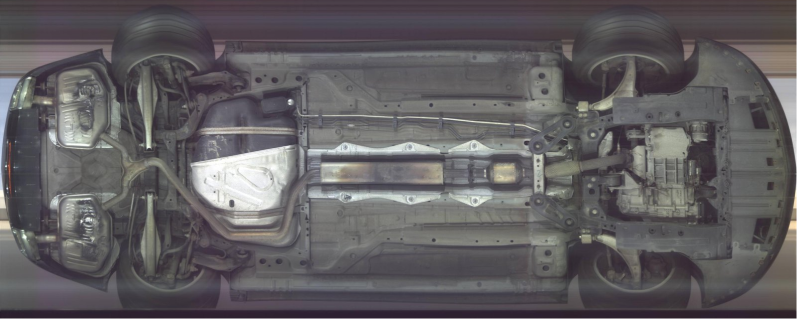
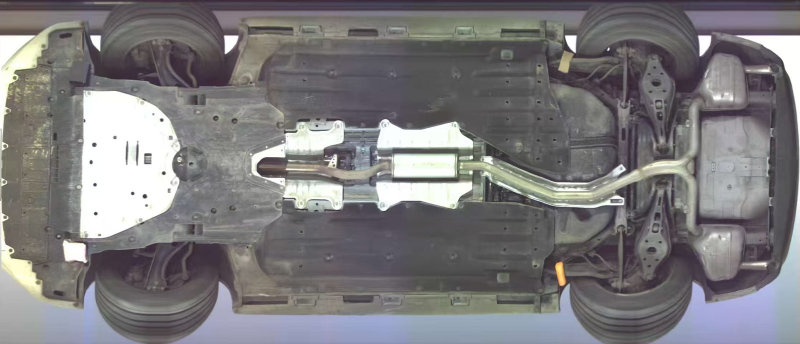
A complete undercarriage captured as a single undistorted image, front bumper to rear axle.
01 What Makes Supercars and Next-Generation EVs Harder to Screen
Four things separate a supercar or an electric prototype from a delivery van at a vehicle checkpoint. Each one breaks an assumption that older screening equipment was designed around, and border and customs authorities have treated under-vehicle concealment as a standing threat for years, as the World Customs Organization documentation makes plain.
Ground clearance measured in centimetres
A track-focused supercar can sit less than 100 mm off the road. Add a composite splitter, a rear diffuser or a battery skid plate and the margin is gone. Any deck that sits proud of the road surface will touch the car before inspection begins. The Roadster sharpens the point: with a fan pulling the body down and thrusters pushing it back up, the underbody is part of the car's mechanism rather than a cosmetic shell.
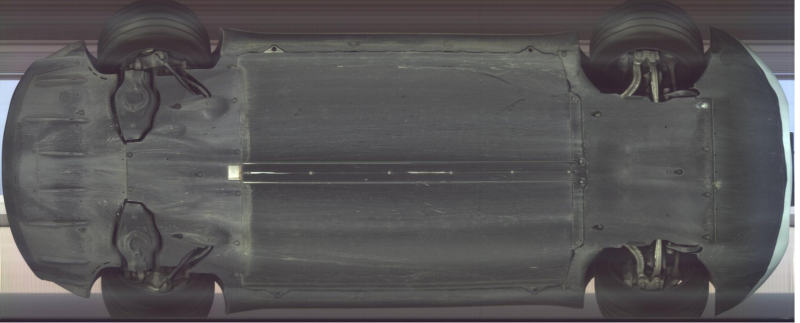
Battery-electric underbody: a sealed floor and a flat battery pack leave no room for a raised sensor deck.
Distortion hides exactly what you are looking for
Wide-angle lenses bend straight lines. Across a full undercarriage image that curvature turns a crack in a battery enclosure into an ambiguous smudge, and a welded-on concealment into a shadow. Inspectors end up zooming into warped pixels and guessing. Undistorted imaging matters because the defects worth finding are millimetres wide.
Factory parts, aftermarket parts and hidden items look alike
A modified chassis, a repaired floor pan and a fabricated hide are all non-standard shapes. An operator working from memory cannot separate them reliably, least of all on a car that left the factory with hand-finished panels. On an EV the puzzle gets harder still, because the battery enclosure and the cooling plate are themselves large, smooth, unfamiliar surfaces. Without a reference image to compare against, the whole inspection rests on how alert somebody feels that morning.
Hand-held mirror inspections run into the same wall. They leave no record, they scale badly with volume, and they put a person underneath an unfamiliar chassis with a low ceiling above them. An imaging system that saves every frame solves all three problems at once.
Motor shows run on throughput, not on one interesting car
An exhibition gate has to keep a queue moving, and exhibitors will not accept a ten-minute stop per transporter. Screening at a show also has to work on a temporary site: no excavation, no permanent civil works, and a clean handoff to the licence plate recognition and access control the organiser already runs. The trade-offs behind that design are set out in our guide to choosing a UVSS.
02 The Answer: Distortion-Free Undercarriage Imaging
Seenboom builds under-vehicle screening systems around area wide scanning sensors. Rather than assembling a picture from a narrow strip as it rolls past, the sensor captures the full width of the undercarriage in one pass and renders it flat. Five capabilities follow from that choice.
Panoramic capture with no distortion
The whole underbody appears in one image with correct geometry, from the front bumper to the rear axle. Scratches, hairline cracks and surface defects stay readable at inspection time instead of collapsing into a distorted edge. On a vehicle whose floor pan is structural, that difference decides whether a mark is cosmetic or a problem.
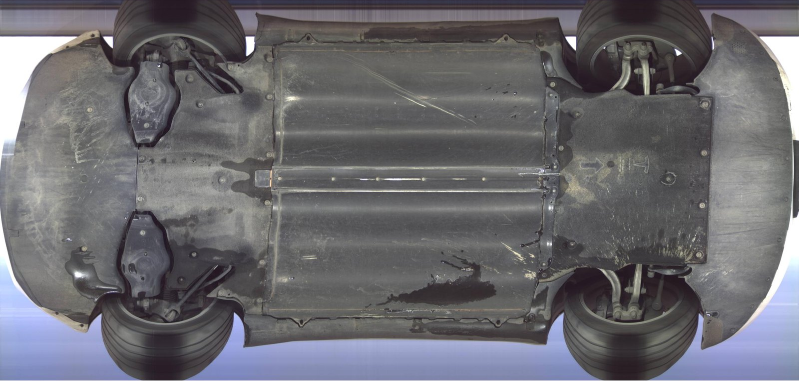
Reference comparison flags a surface defect on an electric vehicle underbody automatically.
AI comparison against a stored reference
The system keeps a baseline capture and compares every later visit against it. Chassis modifications, fresh structural damage and suspicious attachments are flagged automatically, so the operator reviews a short list instead of a whole floor pan. The same AI undercarriage detection logic runs whether the vehicle is arriving for the first time or for the fiftieth.
Flush, ground-level installation
The sensor sits level with the road. There is no ramp and no raised deck, so nothing catches a low splitter or a carbon diffuser. The unit is rated IP68 and engineered to carry the vehicles that cross it, loaded trucks well above 50 tonnes included, which means the same lane serves a supercar and a service truck without adjustment.
Water ingress is the failure mode that kills sensors in the field, and it is the reason the housing is sealed rather than merely shielded. A lane that sits outdoors through a monsoon, a desert dust season or a German winter keeps working on the same schedule, and the low-clearance vehicle that crosses it never touches a moving part.
The sensor array sits flush with the road surface, so low-clearance vehicles pass without contact.
Open integration through a web API
Licence plate recognition (ANPR) and driver face capture run alongside the undercarriage scan and push results into a site's existing security platform through an open web API. Screening data lands in the same dashboard as access control, rather than in a separate console somebody has to remember to open. That pattern is already standard across our fixed and airport installations.
For a motor show the practical version of this matters more than the technical one. A transporter approaches, the plate is read, the driver is photographed, the undercarriage is captured and the result is attached to the vehicle record, all before the ramp goes down. Nobody has to hold up a queue to fill in a form.
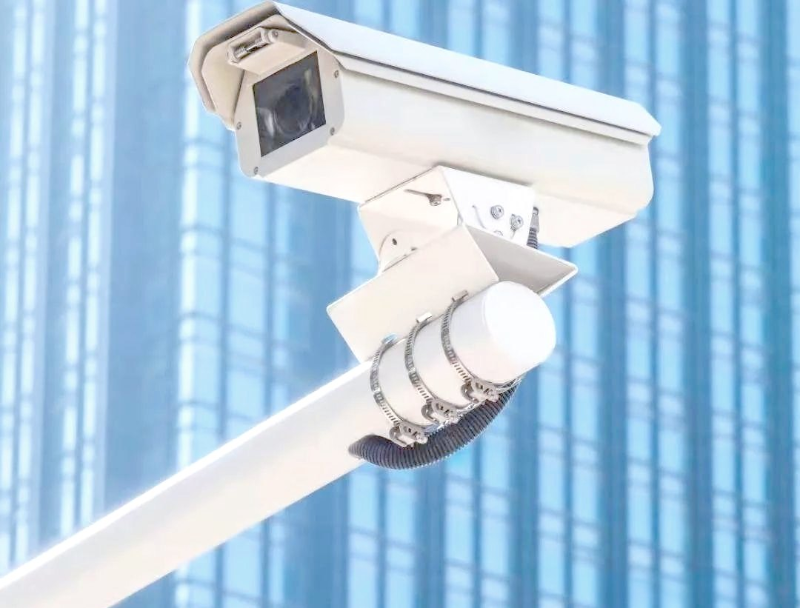 Driver capture camera on the checkpoint lane; plate recognition and face capture run alongside the undercarriage scan.
Hardware for permanent and temporary sites alike
Fixed installations cover permanent gates, ports and land borders. The mobile UVSS range covers shows, temporary venues and field deployments where nothing can be dug into the ground. Both share the same imaging and detection pipeline, so an operator trained on one can read the other.
03 Where This Matters Most
Supercar screening is a small slice of the vehicle security market and a demanding one. Four settings come up again and again in the enquiries that reach us.
Luxury motor shows and concept-car premieres
Exhibitors arrive on transporters with vehicles worth more than the buildings around them. Access control has to move those vehicles without contact and without delay, and organisers increasingly want a record of every underbody that entered the hall. We built the same entry discipline for large public events before concept cars started turning up at them.
VIP motorcades, embassies and royal fleets
A head-of-state vehicle gets screened on somebody else's schedule, often at a location nobody had time to prepare. A ground-level sensor that arrives in a case and works from the pavement suits that better than a permanent pit.
Supercar storage, dealerships and automotive museums
Long-term storage is where underbody tampering is easiest to miss and most costly to discover late. A baseline image taken on arrival turns every later check into a five-second comparison, and it gives insurers a documented record without a manual inspection every quarter. For a collection that moves vehicles between sites, the same reference image travels with the car.
Race circuit paddocks and concept-car intake
Competition rules and prototype confidentiality both depend on knowing exactly what is under a car. A quick undistorted capture before and after a session settles questions that a mirror on a pole never could, and the record is time-stamped and searchable. Where a car is only permitted to run on a closed course, as with the thruster-equipped Roadster configurations, the paddock is the one place the underbody is inspected at all.
The same requirements show up in less glamorous settings. A casino valet lane, a private airfield apron, a defence contractor's vehicle gate and a government motor pool all mix low-clearance cars with higher volumes than a normal checkpoint was designed for. A distortion-free UVSS that reads cleanly on a supercar reads just as cleanly on everything else in the queue.
04 See the Undistorted Image for Yourself at Intersec 2027
Seenboom will demonstrate distortion-free under-vehicle scanning at Intersec 2027 in Dubai, running 12 to 14 January 2027 at the Dubai World Trade Centre. Visitors can watch a live undercarriage capture on a low-clearance vehicle and read the anomaly flags as they appear. The exhibitor programme is published by the organiser.

If a VIP event, a motor show or a supercar facility is on your project list this year, book a private technical session before the show floor opens. Bring a vehicle profile and we will work through clearance, throughput and integration with the platform you already run. Our stand number will be confirmed closer to the show, and registered enquiries will be told first.
For the product brochure, reference projects and a site quotation, email zhangxiaohui@seenboom.com or message us on WhatsApp. Tell us the vehicles you expect at the gate and the throughput you need, and we will size the lane around it. Project and OEM conversations are welcome through our partnership desk.
05 What Comes Next
Electric supercars and future-mobility concept cars will keep changing shape. Floors will get flatter, panels will get thinner, and more of the underside will become load-bearing hardware rather than empty space. Screening equipment has to move in the same direction, or it becomes the thing that damages the asset it was bought to protect.
Seenboom's position is straightforward. Precise, non-destructive and stable under-vehicle inspection, delivered with the engineering discipline that permanent critical-infrastructure sites already expect and scaled down cleanly for the temporary ones. Protecting the vehicle and securing the perimeter are not competing goals, and the equipment should not force a choice between them.
If you are specifying screening for a show, a motorcade or a collection, the useful starting point is a short list of questions. What is the lowest vehicle you expect? What is the heaviest? How many an hour? Which platform has to receive the data? Answers to those four decide the geometry, the load rating, the lane count and the integration work, and they are the first things we ask on a call. Pricing for these systems depends on the same four answers, so it is worth having them ready.
About Seenboom
Seenboom has worked on under-vehicle screening since 2000 and built its first area-array-based system in 2003. The company supplied screening equipment for the 2008 Beijing Olympic Games and the 2010 Shanghai World Expo, and took part in drafting the national industry standard for the sector in 2014. Its systems are installed across more than 2,000 lanes, backed by over 40 patents, more than 20 further applications and over 30 software copyrights. Read the full company history or browse the product range.