

- Keywords:
- UVSSsupplier Since2000 SEENBOOM
Security Essen 2026 closed at Messe Essen on 25 September, and for four days booth 2B26 did the thing that actually matters at a trade fair: it put working hardware in front of the people who will operate it. The show is the reference meeting point for the European security industry, and the visitors who came were specifying real projects, not collecting brochures. Their sites were border and port screening lanes, airport vehicle gates, correctional facility entrances and government compounds, and their requirement landed in the same place every time. They needed an under vehicle scanning system that captures a distortion-free image of the underside, recognises automatically what does not belong there, and reports the result into the security platform they already run.
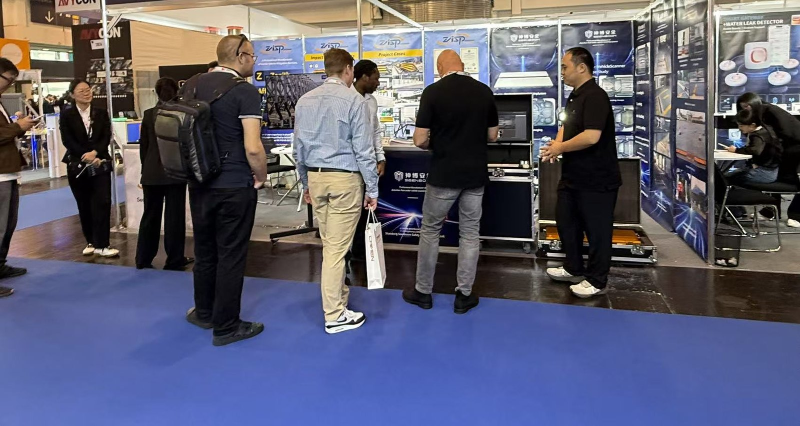
Seenboom booth at Security Essen 2026, hall 2, booth 2B26, Messe Essen, Germany. Photo: Seenboom.
That combination of AI-assisted imaging, automatic foreign object recognition and integrated number plate recognition is what Seenboom brought to Essen, and why the week produced qualified conversations instead of contact-card traffic. The commercial objective was equally specific: to meet European security integrators and engineering contractors, and to deepen cooperation with partners across Germany and the wider European Union. What follows is a recap of what was on the stand, what visitors told us, and how to continue the conversation if you could not make it to Essen.
Key Highlights at the Seenboom Booth
1. An Advanced UVSS Demo Unit, Shown as Working Hardware
The centre of the stand was a fully operational UVSS under vehicle scanning system rather than a cutaway or a rendering. The unit uses area wide scanning with simultaneous exposure across the full lane width, so the whole underside is captured in a single pass and the image is geometrically true enough to be measured rather than merely looked at. The output is a distortion-free high-definition undercarriage image with real-time visual preview at the operator station, which is what makes a lane practical at high throughput, because the image appears as the vehicle crosses and a decision can be taken before the next vehicle is waved forward.
Hardware protection decides whether that performance survives on site. The equipment is sealed to IP67 or IP68 depending on the model, built to keep working through wash-down, standing water, road salt and the full range of outdoor temperatures a critical infrastructure checkpoint actually experiences, from a German winter at one end of the scale to a Gulf summer at the other. Fixed and portable configurations share the same imaging chain, and the trade-off between them is set out in our guide to fixed versus portable under vehicle scanners.
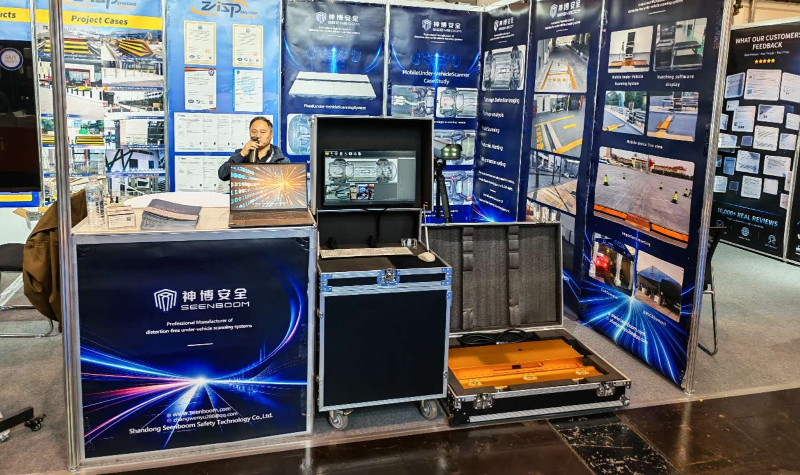
UVSS under vehicle scanning system demo on site at Security Essen 2026, with the transport case open and the operator station running. Photo: Seenboom.
2. AI-Powered Intelligent Detection
Detection was demonstrated live rather than described. The software marks foreign objects attached to the frame, flags suspected contraband, and highlights surface damage such as scratches that a manual sweep would miss. The anomalies arrive already annotated on screen instead of leaving an operator to study a photograph. The method behind it is explained in our article on AI undercarriage threat detection, and the operating cases it is built for in vehicle contraband detection.
Around that core sit the integrations that decide whether a lane fits a site. ANPR number plate recognition binds every undercarriage image to a registration and a timestamp; driver facial capture is available as an option where identity verification is required; and a documented open Web API returns images and detection results to the security management platform, access control and barrier systems the customer already operates. For buyers comparing categories, this is the working difference between a dedicated UVSS and a general under vehicle inspection system.
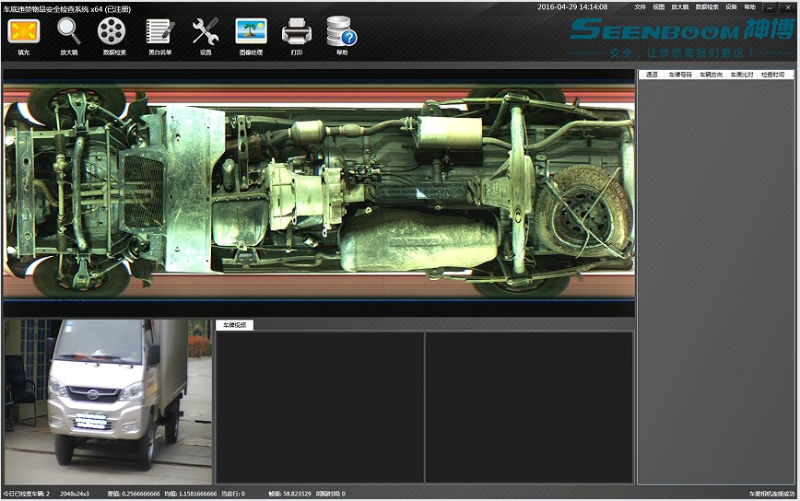
UVSS real-time undercarriage imaging screen display: the operator software returns the full underside image, the number plate and the detection record.
3. Robust Mechanical Design and Project-Level Customization
The mechanical side drew as much attention as the software, especially from contractors fitting equipment into lanes never designed for it. The housing is produced by low-pressure die casting, which yields a sealed and dimensionally consistent deck that can be installed buried and flush with the road surface without rebuilding the carriageway. Structural parts such as the low-pressure die-cast housing and the Ausleitungsadapter adapter plate let an installation be matched to existing lane geometry and drainage rather than the other way round. Where a site cannot take civil works at all, the surface-mounted configuration described in our guide to the portable under vehicle scanner is deployed and moved as the traffic pattern changes.
Customization at this level is documented rather than improvised. For European projects that require supplier quality evidence, Seenboom can deliver a PPAP (Production Part Approval Process) package alongside the technical drawings and test reports, which is the material larger EU tender processes increasingly ask a manufacturer to produce before a purchase order is released. Our article on how to design a vehicle inspection checkpoint covers how those layout and mounting decisions are taken on site.
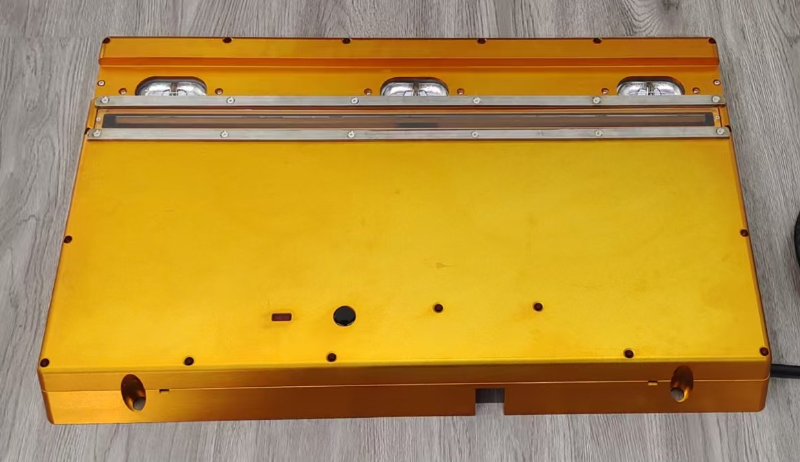 The buried UVSS scan module: a sealed low-pressure die-cast housing with the scan aperture protected for flush
lane installation.
The buried UVSS scan module: a sealed low-pressure die-cast housing with the scan aperture protected for flush
lane installation.
4. A CE-Certified Solution for European Markets
Compliance came up in almost every second meeting. Seenboom's equipment carries CE marking, assessed against the EMC Directive 2014/30/EU and the Low Voltage Directive 2014/35/EU, and the manufacturing operation is certified to ISO 9001:2015 for the production of vehicle undercarriage safety inspection scanning systems. For a European buyer that is the difference between a product that can be admitted to a project and one that cannot. Delivery can be arranged under multiple Incoterms, including FOB and DAP, so procurement can align the shipment with its own project logistics.
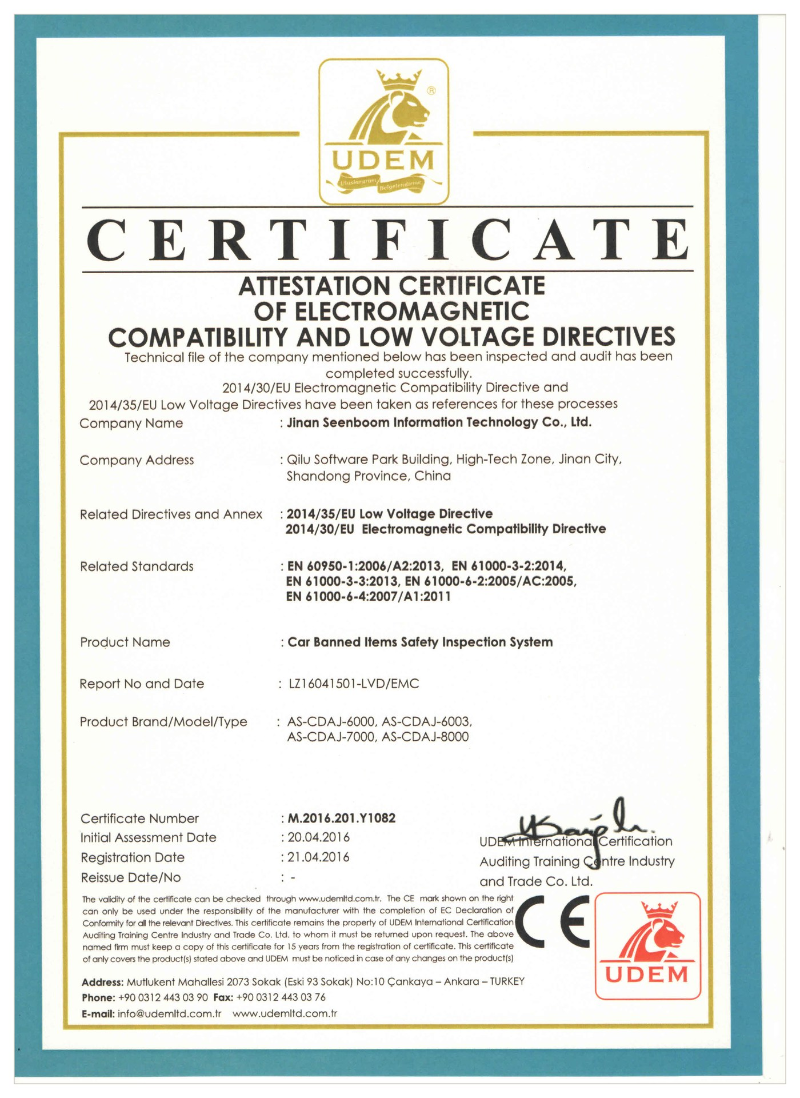
Seenboom CE certificate covering the Electromagnetic Compatibility (2014/30/EU) and Low Voltage (2014/35/EU) Directives.
Conversations and Market Insights from Security Essen 2026
Four visitor profiles dominated booth 2B26: German and wider European security integrators specifying additional lanes; border control project owners; port and logistics park operators; and construction security contractors responsible for site vehicle access.
Their requirements converged quickly, and almost none of them were about image resolution. The priorities were the stability of an outdoor device across years of weather, ease of integration with a platform already in place, low maintenance cost over the life of the installation, and local technical support with a named contact rather than a ticket queue. Two questions kept returning: can the detection software be updated remotely, and will spare parts and replacement decks still be available ten to twenty years from now. For a lane that must not fail during an inspection campaign, the second matters more than any line on a specification sheet.
The commercial outcome was a set of qualified follow-ups rather than a stack of business cards. Several integrators asked for a project-specific configuration. Port and airport operators asked for the documentation needed to compare the system against the method they currently use. The background for airports is collected in our guide to under vehicle scanning systems for airports, and for high-security sites in fixed UVSS solutions for correctional facilities. Every conversation fed back into product planning: the European requirements we heard are being turned into configuration options rather than treated as one-off requests, which is exactly what customs and border checkpoints need from a long-term supplier.
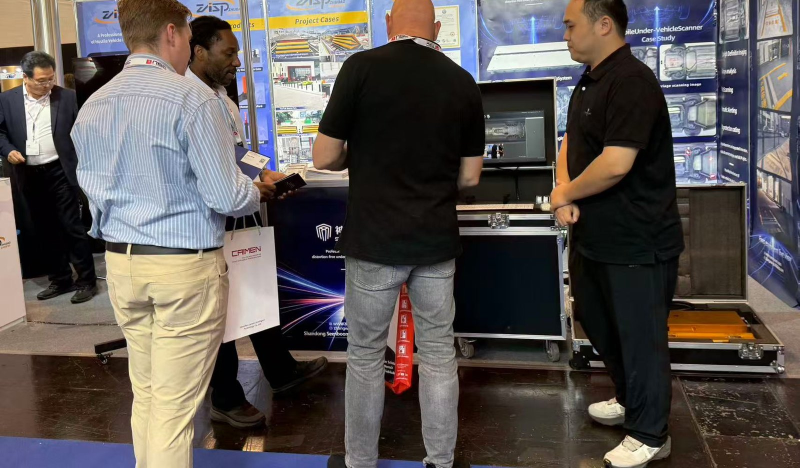
Seenboom team communicating with visitors at Security Essen 2026, booth 2B26. Photo: Seenboom.
Area Scan UVSS: How It Compares for Under Vehicle Surveillance
A technical question that came up repeatedly at booth 2B26 is hard to settle in a two-minute stand conversation: what separates an area scan UVSS from the older line scan approach to under vehicle surveillance, and which one should a project specify. Both terms describe how the imaging head of an under vehicle inspection system is built, and the difference is not academic. It decides how the system behaves when vehicle speed is not constant, how much extra hardware sits in the lane, and how much of the result an operator can trust without taking a second look.
A line scan camera uses a single narrow row of sensor elements and assembles the undercarriage image one line at a time as the vehicle travels over the unit. Because every line is captured at a different moment, the finished image is only geometrically correct if the system knows exactly how fast the vehicle was moving and at what rate to stack the lines. That demands speed measurement hardware in the lane and a defined, repeatable crossing speed, and it still produces a picture that stretches or compresses as soon as a driver accelerates, brakes or stops. It also means more components in the lane to calibrate, clean and replace.
Area wide scanning works the opposite way. A two-dimensional sensor array exposes the full width of the lane at the same instant, so a complete cross-section of the underside is captured in a single pass and successive sections are assembled into one continuous image. Capture does not depend on vehicle speed at all, which is why the result is geometrically true enough to be measured rather than only looked at, and why the image reaches the operator station in real time even in stop-and-go traffic.
For a checkpoint that sees a mixed vehicle mix, that difference shows up as image stability, fewer lane components and a lower maintenance load over the life of the installation. Seenboom has built its imaging chain around area wide technology since 2003, and the principle behind it is set out in our article on area wide scanning, with the wider selection criteria covered in the UVSS working principle and buying guide and the category comparison in UVSS versus a general under vehicle inspection system.
Portable Under Vehicle Inspection System for Temporary Security Sites
A second recurring question came from a different direction. Several visitors were not specifying a permanent lane at all. They were responsible for temporary security sites: the checkpoints that exist for a summit or a state visit, a major sporting or cultural event, an exhibition ground, a disaster relief staging area, a seasonal border post, or a large construction and energy site. Some of those sites are gone within a week, and none of them can justify excavation, drainage work and permanent power and data infrastructure.
A portable under vehicle inspection system is therefore specified against a different set of criteria. It has to travel as a kit, be operational in the lane the same day, and pack down again when the event ends. In practice that means a scan deck laid on the carriageway surface with ramp sections rather than one buried in it, a control cabinet in a wheeled flight case, power taken from the site supply or a generator instead of a dedicated feed, and a software station that can run standalone or forward results over a mobile network. Vehicle flow is usually single lane and mixed, and the people operating it are rarely specialist technicians, so the interface has to be self-explanatory.
Five things decide the outcome when a project team compares portable units: how many cases the system travels in and whether a two-person crew can move them; how long set-up and pack-down actually take; the range of vehicle classes and wheelbases the deck can accept; how the equipment stands up to rain, dust and standing water in the open, where there is no building to shelter it; and whether the unit can later be installed permanently in a lane if a temporary site becomes a permanent checkpoint.
Seenboom's mobile series is built for that requirement. It shares the same area wide imaging chain and the same software platform as the fixed range, so a unit deployed for an event produces images, number plate records and detection results in the format the security team already works with, and it can be moved on to the next site or transferred into a permanent lane rather than retired. The trade-off between the two families is set out in our guide to fixed versus portable under vehicle scanners, and the equipment itself is listed under the mobile under-vehicle scanner and the mobile series.
Why Seenboom UVSS?
Fast deployment. Because the deck sits buried and flush with the lane surface, a system can be planned into a new build or retrofitted into an existing checkpoint without rebuilding the carriageway, and where civil works are impossible the surface-mounted unit goes straight into service. Clearance height, lane width and drainage are the constraints that matter, and all three are resolved at design stage rather than on the day of installation.
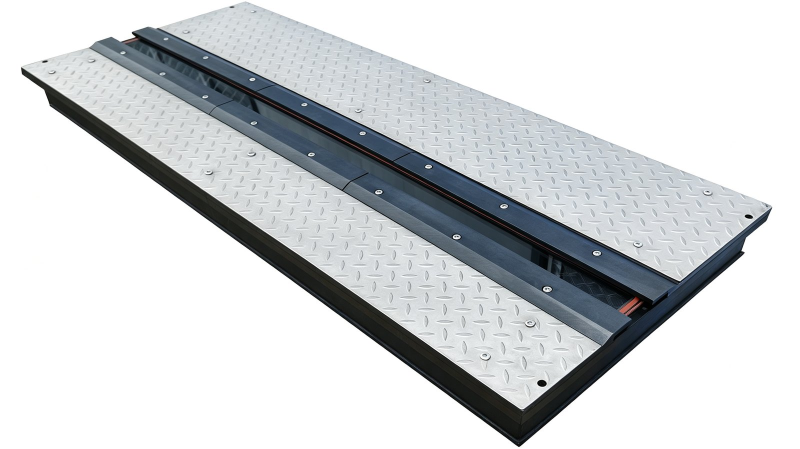
Seenboom fixed UVSS deck, designed to sit flush with the lane surface so an existing carriageway does not have to be rebuilt.
One integrated software platform. Images, detections, number plate data and operator actions are handled in a single interface with remote management and log retention. An under vehicle inspection has to be auditable years later, which is exactly what a review of security vehicle search procedures demands: a complete, searchable record of what crossed the lane and what was done about it, rather than a folder of photographs.
A complete project documentation pack. Technical drawings, test reports and PPAP documentation are issued for tender-level projects, so a contractor is not left assembling compliance evidence after the order. For the wider context, start with our security checkpoint solutions overview and the UVSS working principle and buying guide, and for the equipment itself see the fixed series and the distortion-free fixed unit.
Next Steps: Book a Demo or Request the UVSS Datasheet
The stand is packed away; the engineers are not. If your project is still at specification stage, the most useful next step is a short online demonstration of the detection software against your own vehicle classes, followed by the technical handbook and a configuration proposal written for your site: lane width, vehicle mix, daily throughput, the environment to be survived and the platform the system must report into.
Book a demo or request the UVSS datasheet from the product centre, arrange a one-to-one technical call with a Seenboom sales engineer, or email zhangxiaohui@seenboom.com. The contact page lists WhatsApp and the other channels. Integrators and distributors who want to represent the range in Germany or elsewhere in the EU can start from the partnership enquiry page, where OEM and project cooperation are handled.
Looking Ahead: The Story Continues After the Show
Security Essen 2026 was a milestone rather than a conclusion. Seenboom will keep refining under vehicle scanning systems for the European market, driven by what European integrators and project owners say they need, and will keep supporting the lanes already in service. The engineers who staffed booth 2B26 remain the point of contact, in English, and the company's record in this field, from requirements work in under-vehicle inspection since 2000 and a first system built on area wide technology in 2003 to more than 2,000 lanes delivered worldwide and technical cover for the 2008 Beijing Olympic Games and the 2010 Shanghai World Expo, is documented in the development history and the company profile. It is a commitment to stay in this market rather than a claim about the past. We look forward to building the next set of critical infrastructure security and perimeter security lanes with partners across Europe and beyond.
About the Author
Crystal Zhang is Overseas Operations Manager at Shandong Seenboom Safety Technology Co., Ltd. She has led the company's international business for more than a decade, covering export sales, distributor development and overseas project delivery across Europe, Southeast Asia, the Middle East and Africa, and coordinates technical support for customers outside China. She attended Security Essen 2026 with the Seenboom team at booth 2B26, and can be reached at zhangxiaohui@seenboom.com.
About Seenboom
Seenboom is a Chinese manufacturer of under-vehicle surveillance systems and perimeter security equipment, working in under-vehicle security inspection since 2000 and registered as a national industry standard drafting unit. The company builds complete checkpoint solutions rather than single products, and supports international certification and OEM cooperation. The full range is listed in the product centre, and delivered configurations are catalogued in the solutions section.
Related Articles
For the full on-site record, read the opening-day report from Security Essen 2026, the closing-day report with our Mid-Autumn Festival greeting and the post-show service review.
For the technology, start with security checkpoint solutions for vehicle screening and area wide scanning, then how to design a vehicle inspection checkpoint, vehicle contraband detection and AI undercarriage threat detection.
For the equipment, see the mobile under-vehicle scanner, the multi-lens AI recognition unit and the fixed under-vehicle scanning system. Independent background is published by the Security Essen organisers, Messe Essen, the British Security Industry Association and CISA.