

- Keywords:
- UVSSsupplier Since2000 SEENBOOM
IP68 UVSS: Why Waterproof and Dust-Proof Ratings Matter for Outdoor Security Checkpoints
Ask what kills an under-vehicle scanner in the field and the answer is almost never the camera. It is the weather around it. Open-air gates at ports, borders, mines, construction sites and commercial yards sit in rain, standing water, airborne dust and - near the coast - salt fog, day after day. A deck that was specced on resolution and recognition speed starts failing eighteen months in: water finds its way past a gasket, dust settles on a lens, the image degrades, and one morning the lane is running on a torch and a clipboard again. Most procurement teams never wrote a single number about ingress protection into the specification.
That number is IP68, and it is not a marketing label. For an outdoor security checkpoint it is the difference between a scanner that screens every vehicle for ten years and one that becomes a maintenance line item from the second rainy season. This article explains what the rating actually means, why outdoor sites need it, where its limits are, and how to verify it before the purchase order - because in the under vehicle surveillance market, the buyers who avoid the most pain are the ones who specified protection first and megapixels second.
01 What a UVSS Does - and Where It Has to Survive
An under vehicle surveillance system (UVSS) produces a corrected, full-width image of a vehicle's underside as it drives over a scanning unit, then presents that image - with AI marking of suspicious regions and an ANPR record of the plate - to an operator in a single queue. It is the layer of security checkpoint solutions that sees the part of the vehicle no gate camera reaches: fuel tanks, wheel wells, chassis rails, bolted-on objects. How the image is produced matters less than whether it is produced; a full walkthrough is in how an under vehicle surveillance system works.
The environments where these systems are deployed are overwhelmingly outdoors: border crossings, port and terminal gates, mine and quarry entrances, construction sites, airport service roads, stadium and event cordons, and the entrances of industrial parks. Seenboom's project references for border installations and temporary event screening are all open-air lanes. Each of those sites adds its own attack on the hardware - and that attack is what the IP rating exists to answer.
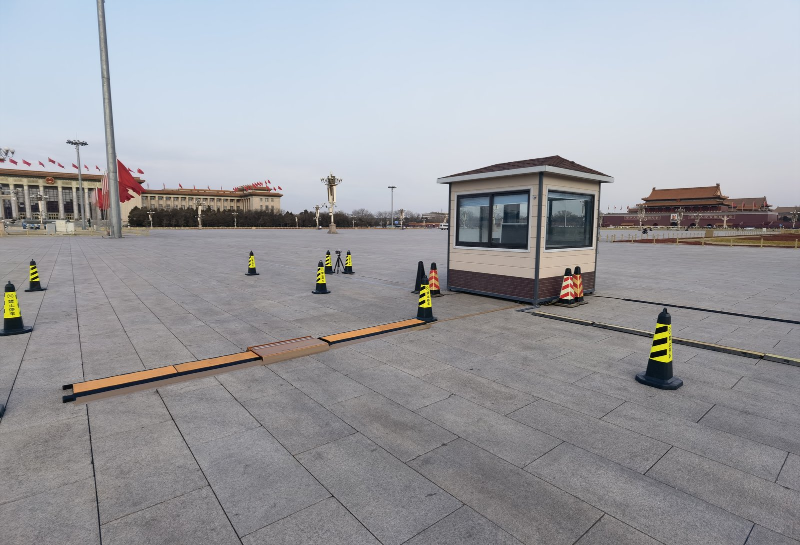
An open-air checkpoint lane: the scanning unit, cabinet and cabling live outside in every season.
02 IP68, Explained Without the Marketing
IP stands for Ingress Protection, and the two digits that follow are defined by the IEC 60529 standard. They are not chosen by the manufacturer's PR department; they are earned in laboratory tests.
- First digit, dust. 6 means dust-tight: no ingress of dust at all, verified in a chamber where the enclosure is bombarded with fine talcum-like powder under negative pressure. Lower digits admit progressively more - 5 means limited dust ingress that does not interfere with operation, which is a different promise entirely.
- Second digit, water. 8 means the enclosure can be continuously immersed in water at a depth and duration the manufacturer specifies, without ingress. 7 stops at temporary immersion - one metre for thirty minutes. 6 stops at powerful jets.
The comparison matters because datasheets blur these lines. An IP65 unit survives heavy spray; it is not built for standing water, and a pressure washer at close range will find the seams. An IP67 unit survives thirty minutes in one metre of water; a flooded lane during monsoon season exceeds both the depth and the duration, and repeated thermal cycling works the gaskets until the margin is gone. Add the routine reality of outdoor checkpoints - weekly high-pressure washdown of the deck, dust storms at quarry gates, salt spray at port terminals - and the reasons a buyer should insist on the full IP68 rating for the scanning unit itself become straightforward.
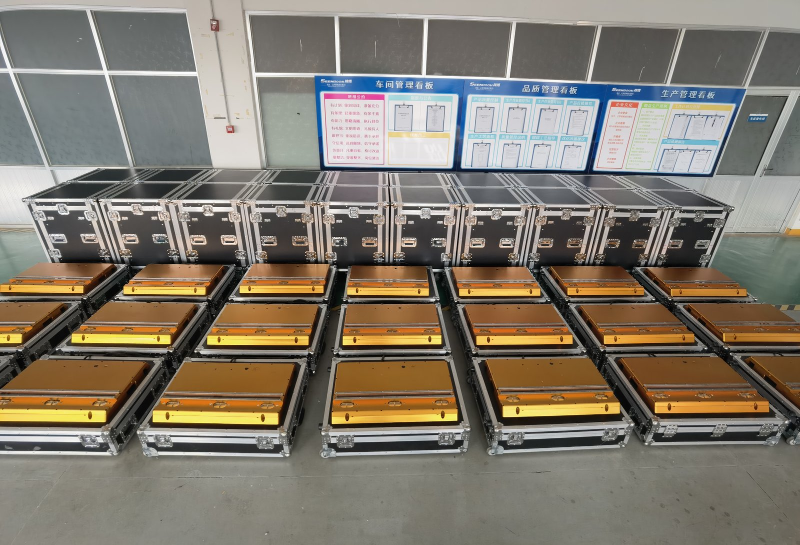
Sealed scanning decks ready for deployment: the enclosure, glass and cable entries are the first line of defence.
03 Why Outdoor Checkpoints Need IP68
Water arrives from three directions at once. Rainstorms drop centimetres of water in an hour and pool across lanes that were graded flat. Seasonal flooding turns a checkpoint into shallow river for days. And the most reliable inundation of all is the operator's own pressure washer, applied weekly to keep the deck readable - a jet test the IP65 rating cannot survive.
Dust and salt are slower but just as decisive. Mine and quarry entrances generate continuous abrasive dust that works into every seam and abrades optical windows. Coastal sites add salt fog, which corrodes connectors and cable glands long before any seal is visibly damaged. Desert and border sites combine both with wide daily temperature swings that open and close every joint in the enclosure, twice a day, for years.
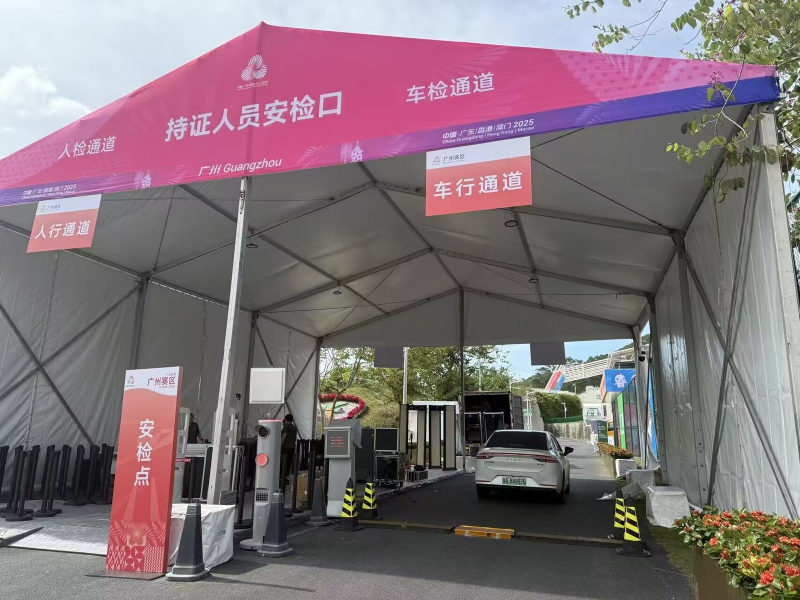
A checkpoint lane exposed to the elements: rain, washdown water and dust all end up on the scanning hardware.
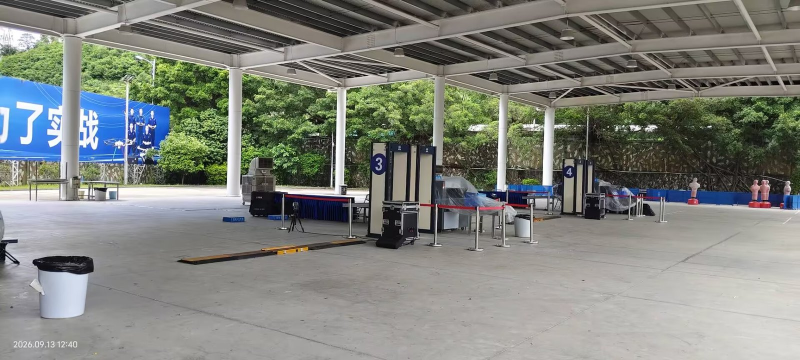
An open-air screening site: no roof, no shelter, and no pause in the traffic when the weather turns.
The operational requirement leaves no room for weather days. A checkpoint is staffed and funded to screen twenty-four hours a day; every hour a scanner spends down is an hour the lane runs on manual inspection, or worse, runs without inspection at all. Downtime is not an inconvenience - it is a security gap with a timestamp on it.
Inside the enclosure, the failure chain is well documented. Dust on a lens or LED array softens and darkens the image. Moisture that passes a tired gasket condenses on the underside of the glass, and the scan turns blotchy exactly where the evidence would be. Water reaching a circuit board means intermittent faults, then shorts, then a unit in a repair loop while the lane sits half-closed. The image quality these systems are bought for only survives if the environment stays outside - which is also why low-clearance vehicles are the strictest test of a well-sealed deck: a Tesla Roadster undercarriage rides barely a hand's width above the scanning surface, and any fogging, dust film or water sheet on the glass erases the fine detail of that flat floor pan before the operator ever sees it.
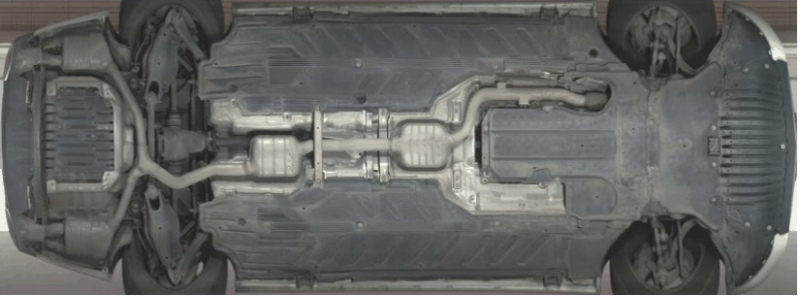
What a healthy, sealed deck produces: a corrected, evenly lit undercarriage image, pass after pass.
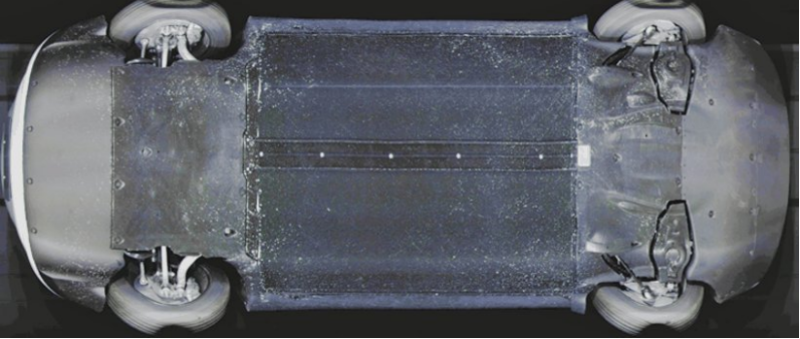
A low-clearance electric vehicle scan: smooth floor pans leave nowhere for detail to hide behind - the optics must stay spotless.
The long-term arithmetic favours protection even more strongly than the failure stories suggest. Spending across the automated vehicle bottom scanning system market keeps rising, but the operators who cost the least per year are consistently those who bought the better-sealed unit: a lower-grade scanner pays the price difference back several times in callouts, gasket and window replacements, loaner logistics and - the largest item by far - lost screening hours during each repair. The full cost comparison between equipment tiers is set out in the UVSS price guide.
04 What IP68 Does Not Mean
A rating is a laboratory result, not an indefinite warranty, and honest suppliers are specific about the boundary. IP68 assumes the enclosure was installed correctly: cable glands tightened to spec, seals seated, penetrations sealed as designed. It assumes the seals are inspected on the maintenance schedule and replaced when they age. It does not cover a deck that was dropped during installation, a gland left finger-tight after a cable swap, or damage from deliberate force - and it does not mean the unit can sit beyond the depth and duration the manufacturer actually specifies for the second digit. Ask what depth and what duration the 8 was tested to; a serious supplier answers without being asked twice.
Sealing alone is also not the whole design. A perfectly sealed enclosure that cools at night draws humid air in through its breathers, and the moisture condenses on the inside of the scanning glass - a fogged window on a dust-tight, watertight unit. That is why proven outdoor designs pair ingress protection with anti-condensation measures: pressure-balanced breathers, desiccant, controlled drainage of the housing interior, and thermal management that keeps internal surfaces above the dew point. Sealing keeps water out; the condensation design keeps the view clear. A checkpoint needs both, and the specification should name both.
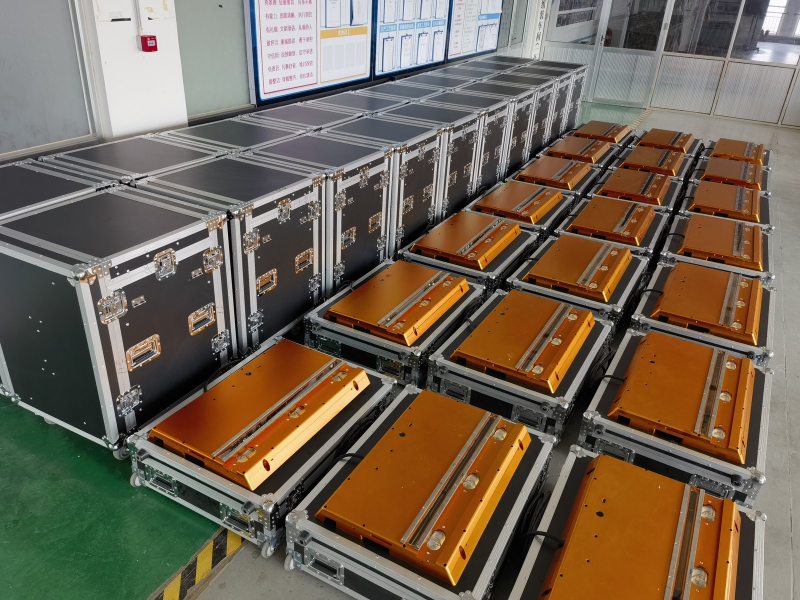
Field hardware prepared for outdoor duty: sealed units, protected connectors and planned cable routing.
05 How to Specify and Verify IP68 Before You Buy
Do not take the rating from a brochure page. Ask for the third-party IP68 test report for the scanning unit, issued by an accredited laboratory, and check that the report names the tested depth and duration. A manufacturer that has actually paid for the test will produce the certificate; one that has not will send a paragraph of marketing text. This single request filters suppliers faster than any comparison table, and the UVSS supplier checklist organises the rest of the pre-purchase questions in the same spirit.
Then check where the rating applies. A complete outdoor installation has at least four ingress-critical parts: the scanning unit itself, the illumination modules, the control cabinet, and every cable connector between them. Some offers carry IP68 on the deck and an unrated junction box beside it - the system is only as sealed as its worst penetration, so the specification should require IP68 (or an explicitly justified equivalent) on all of them, not on one component.
Match the rating to the site rather than defaulting to the top number everywhere:
- Urban and campus checkpoints, sheltered yards: IP67 is the practical minimum, IP68 recommended - washdown water alone justifies it.
- Ports, coastal terminals, mines, quarries, open border lanes, flood-prone sites: IP68 on every ingress-critical component, with the site's salt, dust and immersion exposure written into the tender.
Finally, plan the installation so the environment stays manageable: mount on a drainage plinth so the deck sheds water instead of sitting in it, route conduit above the seasonal water line, avoid placing the unit where standing water collects after rain, and schedule seal inspection into the maintenance contract from day one. The civil side of these decisions is covered step by step in how to design a vehicle inspection checkpoint, and the choice between a buried or surface-mounted deck - which changes the drainage design completely - is compared in buried versus raised installations.
06 How Seenboom Builds for These Sites
Seenboom's under-vehicle scanning platforms are sealed to IP68 as complete units: the imaging array modules and the LED illumination are integrated into one sealed structure, so there is no weak junction between a camera bracket and a light housing for water or dust to exploit. The decks are rated to withstand high-pressure washdown, which is how outdoor checkpoints actually get cleaned, and they are in daily service at coastal, dusty and high-rainfall sites across Seenboom's border, port, industrial park and large-project references. Where axle loads on those routes are uncertain, the heavy-duty platform range is tested above 70 tonnes.
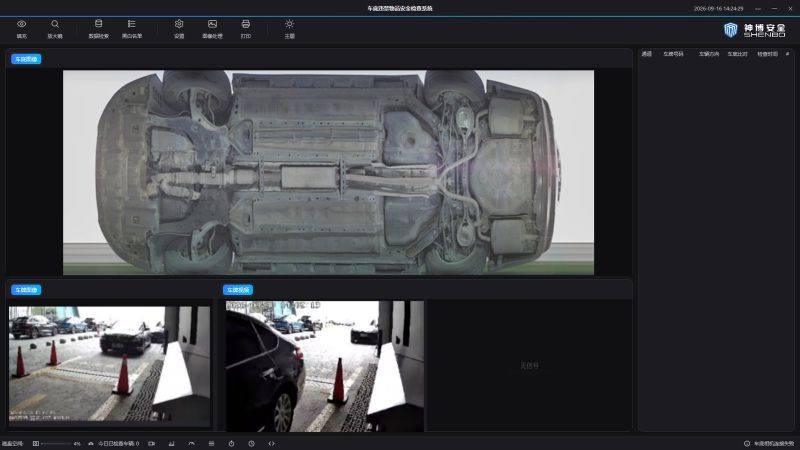
The operator's view in a harsh-environment deployment: AI-marked anomalies and the ANPR record beside a clean scan.
Protection is only useful if the intelligence on top of it keeps working, so the same platforms pair the sealed hardware with AI undercarriage anomaly detection and ANPR recognition that remain stable in dust, rain and low light - marking regions for the officer instead of asking them to search a raw image. The integration approach is described in how AI and ANPR integrate into under-vehicle inspection. The practical result for the buyer is the one this article has been circling: long stretches of unattended, continuous screening with maintenance reduced to scheduled seal checks and window cleaning, which is what makes batch deployments across a border line, a port estate or a multi-site industrial park affordable to operate.
07 Conclusion
For an outdoor security checkpoint, continuously capturing a clear undercarriage image is the first premise - everything else, from AI detection to ANPR to record-keeping, sits on top of it. Weather is the one force working against that premise every hour of every day, and the ingress protection rating is the specification that answers it. IP68 is not a premium feature; it is the bottom line for a scanner that lives in rain, washdown water, dust and salt air, and it is what keeps a checkpoint screening instead of repairing.
So weigh protection at the same priority as imaging performance and recognition algorithms when you evaluate offers: request the third-party test report, confirm the rating on every component rather than one, and match the requirement to the site's real exposure. Across the under vehicle surveillance market, the deployments that still screen vehicles five years on are the ones that specified protection before megapixels - slightly more on day one, measurably less every year after, and still on the lane while the cheaper alternative is on its second repair cycle.
08 Request Test Certificates and an Outdoor Site Review
Seenboom provides the third-party IP68 test certificate for its scanning platforms on request, together with reference cases from outdoor deployments - border lanes, port terminals, mining and event sites - so you can verify the claims against operating sites rather than datasheets.
Send your site exposure - climate, dust, distance to the coast, expected traffic - with a photo or drawing of the lane to zhangxiaohui@seenboom.com, or message WhatsApp +86 183 6310 1063. You will receive a protection-matched configuration recommendation, an itemised quotation, and the option to book a live demonstration or a site survey before you commit. The contact page lists the fastest ways to reach the team.