


Beyond the Mirror: Data-Driven Customs Security with Advanced UVSS Technology Enhancing Border Security: How Under-Vehicle Scanning Systems Greatly Improve Customs Inspection Effici ency In the global logistics network, border crossings and customs checkpoints.
Beyond the Mirror: Data-Driven Customs Security with Advanced UVSS Technology
Enhancing Border Security: How Under-Vehicle Scanning Systems Greatly Improve Customs Inspection Efficiency
In the global logistics network, border crossings and customs checkpoints act as critical gateways for trade. However, these high-volume hubs are also frequent spots where concealed restricted goods and safety risks emerge. For customs security decision-makers, the challenge is clear: how to maintain the rapid flow of legitimate commerce while ensuring that potential safety hazards do not cross the border.
Consider the scale of the challenge: major land ports often process 3,000 to 5,000 vehicles per day during peak seasons. Traditional inspection methods simply cannot keep up with this volume without creating traffic bottlenecks. For decades, the standard tool for inspecting vehicle undercarriages was a simple convex mirror. Today, the deployment of the Under-Vehicle Scanning System (UVSS) has become a widely trusted mainstream solution in customs security, delivering remarkable progress in inspection speed, identification accuracy and staff safety.
The Growing Complexity of Border Security
The core difficulty for modern customs lies in balancing inspection efficiency and border safety. Halting every vehicle for full manual physical inspection brings substantial operational losses. Industry data suggests that manual undercarriage inspections take an average of 3 to 5 minutes per vehicle. At a busy border crossing, this can result in lengthy vehicle queues and cumulative time losses that impact regional trade operations each year.
Moreover, over-reliance on manual inspections creates noticeable blind spots in safety screening. According to security industry reports, most concealed prohibited and hazardous items are hidden within vehicle chassis or undercarriage components. This area features many hard-to-check spaces, such as inside spare tires, behind fuel tanks, or within modified axle assemblies. These hidden positions are often difficult to fully check with the naked eye or handheld mirrors, especially under low light or harsh weather conditions that reduce visibility.
On-site staff safety is another key consideration. Manual inspections require officers to crouch or lie beside vehicles during checks, exposing them to vehicle exhaust and physical collision risks. Automated scanning solutions can largely eliminate such occupational risks for inspection personnel.
The Solution: High-Speed Digital Imaging and AI
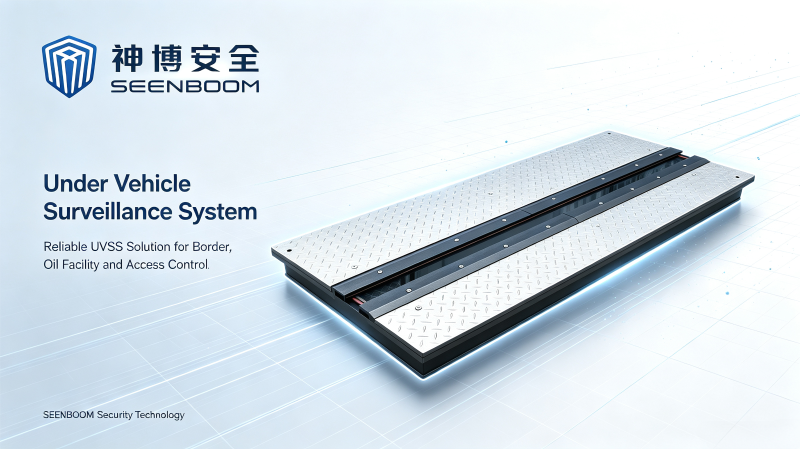
To address these challenges, forward-thinking customs agencies are adopting automated UVSS solutions. An Under-Vehicle Scanning System uses high-resolution line-scan cameras to capture a complete, clear image of a vehicle's chassis as it travels over the scanning unit.
The efficiency improvement is immediately observable. With a UVSS, vehicles can be scanned while moving at speeds of up to 30 km/h. This shortens single-vehicle inspection duration from several minutes to only a few seconds, bringing substantial efficiency upgrades for checkpoint operations.
Yet the core advantage comes from intelligent identification software. Modern systems are equipped with AI-powered automatic threat identification functions. The system compares scanned undercarriage images against a database of standard vehicle templates. Shenbo’s system features a resolution of up to 20,000 pixels, capable of capturing tiny structural differences on vehicle bottoms. The AI tool automatically marks abnormal structures such as extra attached objects or refitted components. Compared with fully manual screening, the system can effectively lower the risk of missed hidden risks while reducing misjudgments caused by staff fatigue.
Shenbo Technology: Engineering Precision for Border Control
At Shandong Shenbo Security Technology Co., Ltd., we understand that customs security requires hardware durable enough to adapt to complex working environments. We have spent years optimizing UVSS equipment specially for high-traffic, high-safety-demand scenarios, with all products passing rigorous multi-scenario testing.
Shenbo’s Under-Vehicle Scanning Systems are built for long-term stable use. Our scanning platforms adopt thickened pressure-resistant steel plates, which can bear axle loads of up to50 tons, covering inspection demands from private passenger cars to full-load container trucks.
Our equipment is also designed to adapt to global deployment environments. Internal electronic parts maintain stable performance within an extreme temperature range of -40°C to +70°C, supporting continuous operation in cold northern regions and high-temperature arid areas alike.
Key features of our UVSS solutions include:
1. High-Definition Imaging: Linear scanning cameras output sharp undercarriage pictures, clearly presenting details in shadowed chassis areas without motion blur during vehicle passing.
2. Seamless Integration: The system supports docking with existing license plate recognition and access control equipment. Practical application data shows integrated security management can greatly shorten the time for staff to respond to abnormal vehicles.
3. Stable Round-the-Clock Operation: Optimized hardware and software structures support uninterrupted all-day running, delivering consistent screening performance for checkpoints every day.
Real-World Impact: A Case for Efficiency
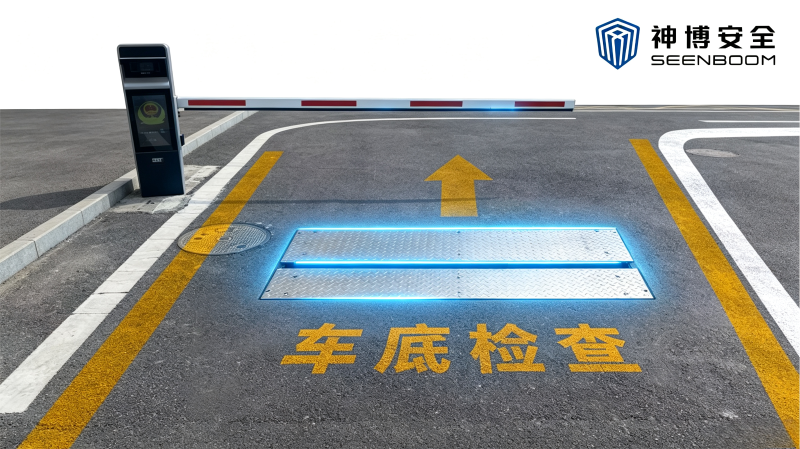
The practical value of this scanning technology can be fully reflected through real port deployment data. A large regional land port replaced traditional mirror manual inspection with Shenbo’s automated UVSS equipment.
The overall operation optimization effect was obvious. The average processing time for each vehicle was cut from 4 minutes to less than 10 seconds. Without adding new inspection lanes or recruiting more staff, the port lifted its daily vehicle handling capacity by 35%. More importantly, within the first six months after deployment, the system’s intelligent algorithm flagged three vehicles with abnormal chassis structures that previous manual checks failed to identify. Follow-up physical inspections confirmed hidden modified storage spaces for restricted goods.
The on-site operation data proves that automatic scanning equipment not only speeds up vehicle clearance but also elevates the overall safety level of border screening work.
Conclusion
The mode of border safety inspection is continuously upgrading. With annual growth in cross-border trade volume, customs management teams can no longer rely on slow, labor-intensive manual inspection methods that are prone to human oversight.
Deploying advanced Under-Vehicle Scanning Systems is a practical investment that brings dual returns in staff safety and checkpoint operational efficiency. It delivers comprehensive undercarriage visibility for inspectors, enabling stable high-precision screening for large batches of vehicles that cannot be fully achieved by manual teams alone.
Shenbo Technology is committed to being a reliable partner for global border safety management, supplying stable, intelligent scanning equipment to safeguard border checkpoint operations worldwide.
Take the Next Step in Securing Your Borders
Do you hope to greatly shorten vehicle inspection time and strengthen your ability to spot hidden safety risks? Are you looking for stable integrated equipment combining fast passing speed and high-definition undercarriage imaging?
Contact Shenbo’s sales team today to arrange a free consultation. Our team will customize a matching UVSS solution according to your actual checkpoint operation demands.
keywords Under Vehicle Scanner UVSS

Service Hotline400-661-6686

to addressBuilding C, Qilu Software Park, Shunhua Road, Jinan Area of China (Shandong) Pilot Free Trade Zone

Email addresszhangwenyu@seenboom.com
 Scan the code to follow the official account
 Scan the code and add me on wechat